

Customs documents: how to avoid delays and in international trade
12/3/2025
Why do shipments get stuck in customs?
Before we look at solutions, we need to understand the issue. Customs authorities don’t aim to block trade; their role is to collect taxes, maintain statistics, and uphold safety standards. When a shipment is stopped, it’s usually due to inconsistencies in the paperwork or missing documents.
Anyone who wants to avoid customs delays needs to work precisely, ensure data quality, and respect the relevant regulations of the destination country. This is essential for any company operating internationally.
The most common reasons for customs delays caused by faulty documents
Incomplete information
The commercial invoice is missing, incorrect, or not accessible on the outside of the parcel. Missing sender or recipient data is also common. Without complete documents, no customs office can verify the content properly.
Vague product descriptions
Terms like “gift,” “sample,” “parts,” or internal item names are not sufficient. Customs must understand: what is the item? What is the material? What is the purpose?
Incorrect tariff number
An incorrect HS code results in wrong duty calculations or import restrictions. It can also lead to additional customs fees for the recipient.
Missing proof of value
Under-declaring the value leads to physical inspections. Penalties drain both time and money, especially for express shipments.
Missing licenses/approvals
Especially for regulated goods such as electronics (CE marking, UN battery codes) or food/cosmetics (e.g., FDA), the required documentation is mandatory. Export control applies here as well.
What happens when customs documents are missing?
In the best case, the shipment is delayed until you provide the missing documents. In the worst case, you face storage charges, fines for incorrect declarations, additional customs fees, repeated import costs, or the return shipment back to your company. That burns money and destroys the customer experience.
The 5 most important customs documents for international shipping
Depending on the destination country, value, and type of goods, you need different customs documents. These 5 items are essential for answering the question “Which documents do I need for export?”
In addition, the applicable regulations of the European Union (Union Customs Code) must be considered – crucial for import and export processes alike.
1. Commercial invoice
The commercial invoice is the basis for duties, taxes, valuation, and import verification. It must be complete, accurate, and transparent for any customs office.
Required for all commercial exports outside the EU.
2. Export Accompanying Document (EAD)
Proof of proper export from the EU (MRN). Essential for VAT exemption.
Required above EUR 1,000 or 1,000 kg.
3. Certificate of origin / preference documents
Certifies non-preferential origin or enables reduced customs fees via preference documents (e.g., EUR.1).
Required depending on destination country or free trade agreement.
4. Packing list
Detailed listing of the shipment contents. Helps every customs office verify the goods quickly.
Recommended for all shipments.
5. CN22 / CN23
Customs declaration for postal shipments.
Mandatory depending on parcel value.
Focus: using preference documents to reduce costs
Many countries have free trade agreements with the EU. With preference documents or certificates of origin, you can prove preferential origin – significantly reducing customs fees upon import into the destination country.
- United Kingdom (UK): under the TCA, shipments may be duty-free if the origin statement is included on the commercial invoice and the rules of origin are fulfilled.
- Canada (CETA): recipients benefit from reduced customs duties when origin statements are correctly declared.
Practical guide: how to complete customs documents correctly
Many merchants know the rules in theory but fail during practical implementation. The following steps give companies more security during import procedures, especially in areas with high export activity.
Master precise product descriptions
Describe the item so clearly that even a layperson can identify it. Material, purpose, use – all relevant. Internal names are useless in customs checks.
Incorrect (high risk)
Clothing
Parts
Cosmetics
Correct (low risk)
Men’s T-shirt, 100% cotton
Replacement wheel hub, aluminum cast
Hand cream, 50 ml, aloe vera-based
Finding and using the correct HS code
The tariff number determines import rules, customs fees, restrictions, and application of customs regulations.
Research tip: Use EZT-online or the German Federal Statistical Office's index.
Correct application prevents companies from losing money or having shipments seized.
Incoterms 2020: clarifying liability
Incoterms define cost, risk, and responsibility distribution between company and recipient.
DDP: the company covers all costs, including import charges. Ideal for recipients, particularly with express shipping.
DAP: the recipient pays duties and taxes – often leading to refused deliveries.
The EORI number and formal obligations
The EORI number identifies companies within customs procedures. Without it, no valid customs declaration is possible. Ensure all documents are complete – customs offices enforce customs law strictly.
Quick win: reduce liability and save costs with accurate customs documents
As an exporter, you are responsible for all data accuracy. Mistakes in HS codes, origin, value, or the commercial invoice can trigger investigations and significant customs fees.
Therefore, always provide full item master data to your fulfillment partner.
A valid customs power of attorney ensures your logistics provider can submit declarations legally and correctly.
Special case: returns from non-EU countries
If customers return goods from the UK, Switzerland, or the US, the goods must be re-imported.
To avoid paying customs fees twice, the shipment must be declared as returned goods.
You need:
- Proof of original export (MRN, tracking ID, invoice)
- Confirmation that the item was not altered
- A professional fulfillment partner handles these measures and prevents unnecessary financial losses for companies.
Automation: how digital solutions scale customs documentation
Manual customs handling is error-prone. When you ship hundreds of parcels daily, automation becomes essential to maintain control across every section of the import/export process.
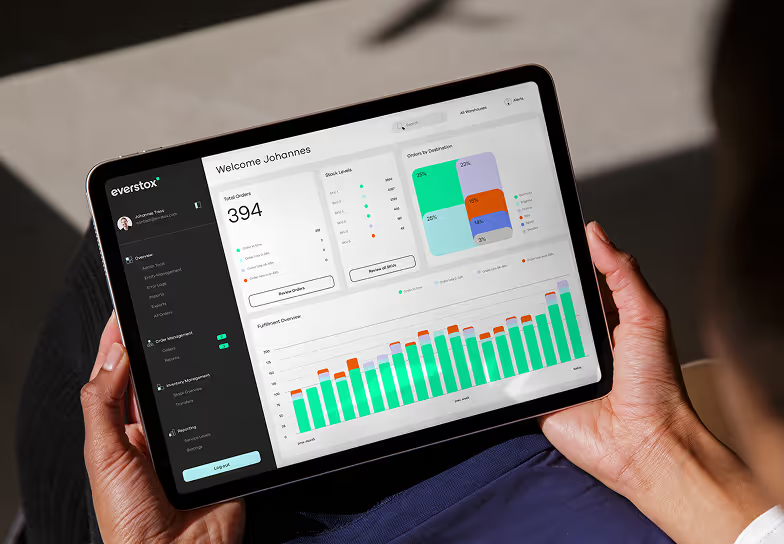
Modern fulfillment platforms like everstox help companies generate and manage all required documents:
- API-based data mapping
- Automated commercial invoices
- Paperless Trade for express shipments
- Validation according to regulations of the European Union
- Clear overview across all process sections
This reduces manual effort and lowers the risk of incorrect declarations.
Conclusion: grow globally with clean customs documentation and strong partners
Customs processes seem complex but become manageable with complete documents, structured workflows, and digital support. Companies that optimize their customs documentation save time, money, and avoid unnecessary customs fees.
With everstox and our global network, you can ensure that your logistics are just as scalable as your sales. A central platform validates your export data, automatically creates documents, and our logistics partners transmit them directly to customs - for smooth shipping to the destination country and a strong customer experience.
Frequently asked questions
What’s the difference between an invoice and a pro forma invoice?
How can I avoid import charges on returns from non-EU countries?
Why do shipments get stuck in customs despite correct invoices?
When do I need an EORI number?
About the author

Anna Kraus
eCommerce and logistics expert
With over seven years of experience in online marketing, Anna is responsible for the content strategy and editorial development of the everstox website. Her work focuses on eCommerce, logistics, and supply chain management, translating complex operational topics into clear, relevant, and actionable insights.
Since joining everstox in 2024, Anna has taken full ownership of the company’s editorial content, including blog articles, in-depth industry pieces, and the complete everstox glossary. Her content connects current trends in eCommerce and logistics with the real-world challenges faced by growing brands, helping decision-makers navigate an increasingly complex operational landscape.
Anna holds a bachelor’s degree from the University of Salzburg and earned a Master of Business Administration with a focus on health management from IU International University. Her master’s thesis on occupational health management reflects her analytical mindset and her interest in how integrated strategies can strengthen long-term business performance.
By combining academic rigor with hands-on marketing experience, Anna delivers content that goes beyond surface-level commentary. Her work offers readers a clear, well-informed perspective on the intersection of digital innovation, logistics, and supply chain operations, with a strong focus on practical relevance and strategic clarity.
More growth, less effort.
Scale fulfillment, shipping, and warehousing with a platform that brings everything together.
More interesting articles
Mastering seasonal peaks: how multi-warehousing helps prevent bottlenecks
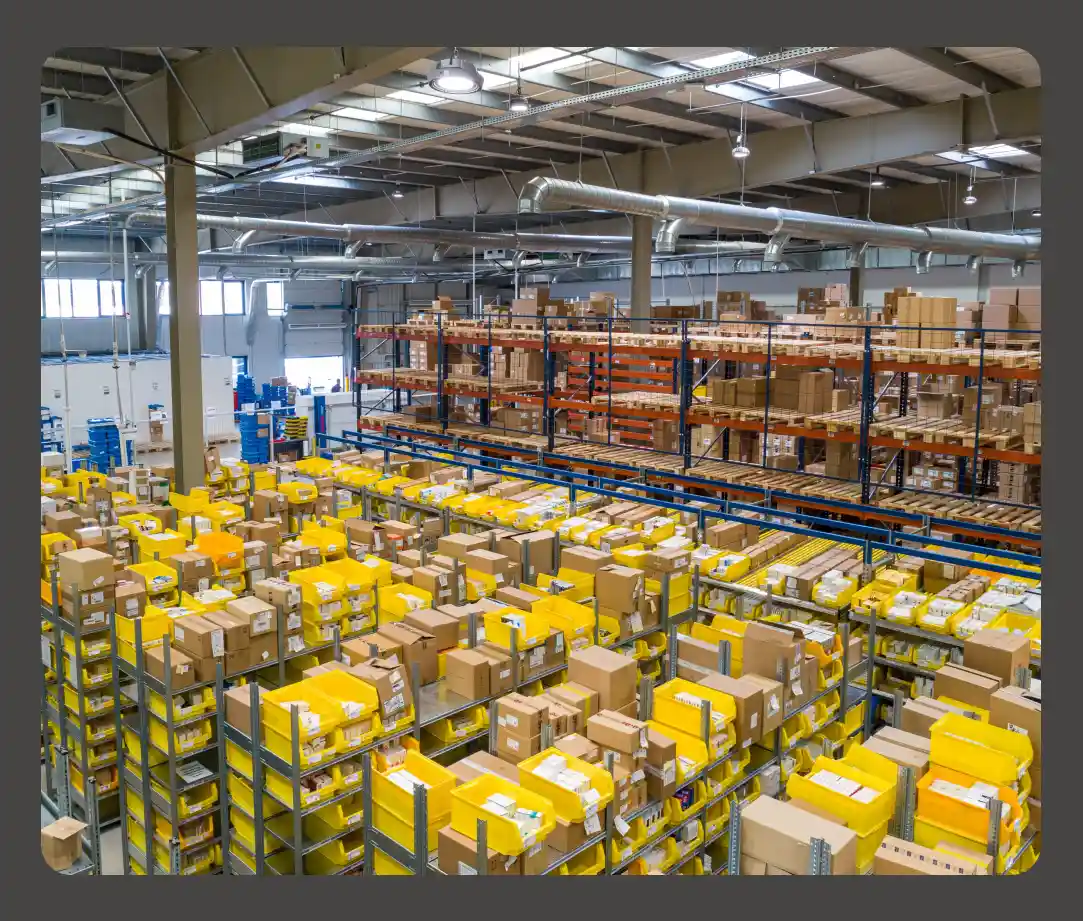
Your marketing campaigns for Black Friday or the holiday season are running at full speed, the servers handle the traffic, orders skyrocket – and then everything stops. Not in your shop, but in the warehouse. When parcels remain stuck, throughput times explode and customers wait for their orders, the “logistics blackout” becomes reality.
A single warehouse location quickly turns into a “single point of failure” during peak season fulfillment. The solution for growing eCommerce and online retailers isn’t a bigger central warehouse, but flexibility: a strategy built on multi-warehousing.
This article shows you why decentralized warehousing has become essential in modern eCommerce. We break down the hidden risks of centralization, highlight the strategic advantages of a multi-warehousing setup and offer a clear guide on how to elevate your inventory management through automation and the right partner network.

Online marketplaces in Germany: opportunities for retailers and brands
Online marketplaces are digital platforms where multiple sellers offer their products, giving customers a wide selection. However, rising competition, high fees, and stricter quality requirements mean that sellers need a clear marketplace strategy and strong fulfillment partners to succeed.

Optimizing order picking: the ultimate practical guide for eCommerce companies
We’ll show you how to increase the pick rate, reduce the error rate, and noticeably lower your order-to-ship time (OTS). The result: shorter delivery times, higher throughput, more customer satisfaction – and more efficient use of your resources across the entire warehouse system.