

How to nail pre‑FBA: mastering Amazon’s strictest logistics
10/29/2025

FBA accelerates demand, but Amazon’s inbound rules are unforgiving. Pre‑FBA exists because Amazon limits on‑hand inventory and optimizes for small, fast‑moving SKUs, pushing brands to stage, prep, and drip‑feed stock from an external warehouse. One wrong label or late truck can trigger penalties and erode margins.
This paper distills the moving parts: why Pre‑FBA is mandatory, what precise prep work matters, how FBM and Seller Fulfilled Prime (SFP) keep you selling when FBA is constrained, and how a single partner can run all flows under one roof.
Industry context: why it’s critical for scaling D2C
- Inventory caps: Amazon sets strict limits and expects weekly (or frequent) replenishment – no “five containers” arrivals.
- Eligibility constraints: bulky, hazardous, or slow‑moving items may not be stored at Amazon at all.
- Penalty regime: mislabeling, mixed batches, or late delivery can mean high fines and performance hits.
- Prime badge fragility: miss cut‑offs repeatedly and you risk losing the badge – and velocity.
Why pre‑FBA exists (and what it does)
Amazon enforces what, how much, and how you ship in. Pre‑FBA is the external buffer that:
- Holds bulk stock outside Amazon.
- Repackages and relabels to Amazon specs (shipping labels + Amazon labels at the carton/master‑carton/SKU level).
- Releases inventory in the exact quantities Amazon permits, on the schedule Amazon demands.
How much is allowed (capacity & restock limits, EU):
Amazon sets restock/capacity limits by storage type (standard‑size, oversize, etc.). These limits change over time and are visible in Seller Central (Inventory Performance or Shipping Queue). Practically, they cap how much you can inbound and hold at any time.
Limits tighten/loosen based on sell‑through and program updates. Treat pre‑FBA as your buffer to stage bulk inventory and drip‑feed within the allowed caps.
Typical pre‑FBA tasks
Repackaging & relabeling
Apply Amazon and carrier labels; conform to carton content rules.
Bundling/kitting
Build sets Amazon can’t (e.g., 2‑packs/3‑packs prepared upstream).
Batch/lot integrity
Keep the same lot for categories where batch mixing degrades CX.
Strict KPI adherence
Hit cut‑off and delivery windows; avoid misdelivery and “arrived late” penalties.
Amazon-driven docs
Execute with the labels and references Amazon (or the merchant) provides.
FBA delivery conditions at a glance (EU):
Carton weight & dimensions (standard inbound)
Boxes typically ≤ 23 kg; historically ≤ 63.5 cm on any side for standard cartons. As of 20 Jun 2025, Amazon increased the maximum box length to 91.4 cm in DE/FR/IT/ES/UK. Boxes ≥ 15 kg require visible “Heavy/Team Lift” labels on multiple sides. Single‑item oversize cartons can exceed 23 kg only under specific oversize rules/programs.
Modes
SPD (small parcel) vs LTL/FTL (palletised). LTL/FTL requires a booked delivery appointment via Carrier Central; the FC confirms a delivery window. Only professional carriers can book. Partnered‑carrier options exist for SPD; Amazon Freight is available for LTL/FTL in many lanes.
Appointments & windows
For palletised freight, carriers must request an appointment ~24h+ in advance and deliver within the assigned window; unbooked trucks are refused.
FBM and Seller Fulfilled Prime (SFP) as pressure valves
Critically review your current contracts with shipping service providers: do the terms still match your shipping volume? Are there surcharges for certain zones or parcel sizes that FBM (Fulfilled by Merchant): use for SKUs ineligible for FBA or during FBA stockouts; operationally like classic D2C B2C orders but routed via Amazon.
SFP: FBM with the Prime badge – same‑day dispatch by a hard cut‑off (e.g., ~14:00 at some sites) and next‑day delivery. Many 3PLs fail here; meeting SFP KPIs consistently is non‑trivial.
Why it matters: when FBA is constrained (caps, stockouts, restricted SKUs), FBM/SFP maintains catalogue availability without sacrificing Prime‑level CX.
Amazon Vendor Program (when it fits)
Operationally similar inbound rigor to FBA, but Amazon purchases your stock and sells it on‑platform. The same prep precision applies.
If deliveries are late or incorrect – penalties & alerts (EU):
Inbound performance alerts are raised for defects (wrong labels, mixed SKUs, over‑weight/size cartons, missed windows). Amazon can temporarily block further inbounds for affected SKUs until you correct the issue.
Unplanned services fees (per unit) apply when Amazon has to label or prep items you didn’t prep correctly.
Inaccurate weights/dimensions or non‑compliant cartons can lead to fees, shipment refusal, or blocked shipping privileges. Use the Shipment Performance dashboard to monitor and resolve problems.
How everstox runs Amazon flows end‑to‑end
Pre‑FBA at scale – receive bulk, store, rework (repack/relabel), and drip‑feed per Amazon limits.
Kitting/Bundling – create retail‑ready sets before Amazon receipt.
FBM + SFP – same‑day dispatch by strict cut‑offs across multiple sites; next‑day delivery where required.
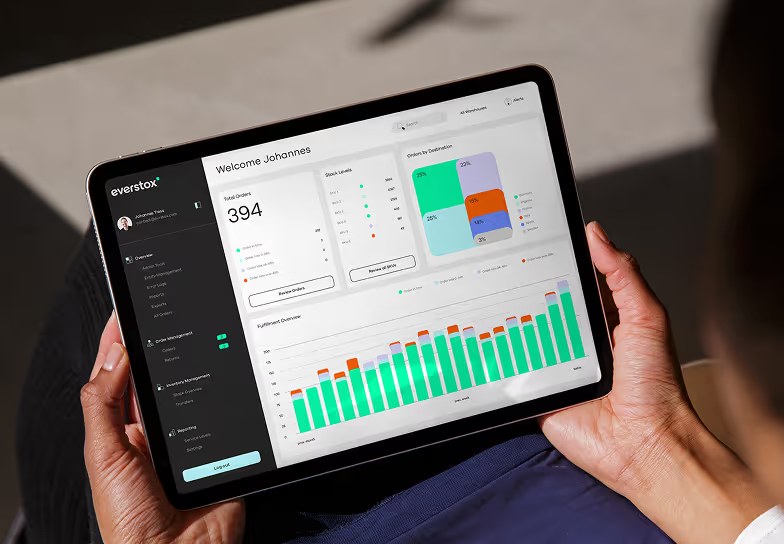
Single platform – one integration and dashboard for visibility, replenishment control, and KPI tracking across sites.
Penalty avoidance focus – process discipline to prevent mislabels/missed windows.
Getting started with FBA (EU setup & enrollment)
If you’re scaling a D2C brand into Amazon’s FBA ecosystem in Europe, here’s your streamlined onboarding roadmap:
1. Set up a European Seller Account
Start with a professional seller account. If you’re already selling in the US, simply add a regional Europe account via Seller Central – Amazon supports unified multi-region operations.
2. Enable FBA
In Seller Central, choose “Fulfillment by Amazon” instead of merchant-fulfilled when listing products. This automatically enrolls them into FBA workflows, including Prime eligibility.
3. Select your fulfillment model
Choose among:
European Fulfillment Network (EFN): store in one EU country; Amazon fulfills cross-border orders for you.
Pan‑European FBA: send your inventory to selected EU countries, and Amazon redistributes it across its network for faster, localized delivery.
For Pan‑European FBA, ensure you have FBA listings in required EU stores, and enable storage in at least two of DE, FR, IT, ES, or PL.
4. Confirm VAT requirements
FBA across Europe triggers a VAT obligation in any country where Amazon holds or moves your inventory. Compliance is required even if Amazon manages movement (this includes Pan‑EU).
5. Create and send shipments
Use the “Send to Amazon” workflow to create your shipping plan. Assign shipping mode (SPD or LTL/FTL), prep and label cartons per spec, and book delivery appointments for palletized shipments via Carrier Central.
6. Track and adjust
Monitor restock/capacity limits in your Inventory Performance or Shipping Queue dashboards. Use Pre‑FBA as your buffer to feed Amazon drip-wise and within these caps.
Practical recommendations
Map your catalogue into: FBA core, FBM/SFP backstop, and FBA‑ineligible (bulky/hazmat/slow movers). Define cut‑offs and SLAs with your provider to keep SFP compliant even on peak days.
Template your labels & work instructions for repack/relabel tasks; remove ambiguity at the station.
Institute lot control where batch mixing degrades CX (e.g., nutrition).
Track penalties weekly and run root‑cause on every incident; tighten SOPs before peak.
Unify flows with one partner to eliminate handoffs between Pre‑FBA, FBM, and SFP.
Key takeaways
Pre‑FBA isn’t optional at scale; it’s the buffer Amazon’s rules demand.
Compliance errors are margin killers; precision in prep and timing is everything. FBM/SFP keeps the catalogue live when FBA can’t.
Consolidate Amazon flows with everstox to simplify ops and protect the Prime experience.
Stay Prime. Stay profitable. With everstox, you get one partner to run Pre‑FBA, FBM, and SFP – so Amazon compliance doesn’t hijack your roadmap.
Prefer a polished read?
Get the full article as a beautifully designed whitepaper – optimized for offline reading, sharing, and team workshops. Same insights, smoother format, high-quality layout. Download your copy below.
Frequently asked questions
About the author

Anna Kraus
eCommerce and logistics expert
With over seven years of experience in online marketing, Anna is responsible for the content strategy and editorial development of the everstox website. Her work focuses on eCommerce, logistics, and supply chain management, translating complex operational topics into clear, relevant, and actionable insights.
Since joining everstox in 2024, Anna has taken full ownership of the company’s editorial content, including blog articles, in-depth industry pieces, and the complete everstox glossary. Her content connects current trends in eCommerce and logistics with the real-world challenges faced by growing brands, helping decision-makers navigate an increasingly complex operational landscape.
Anna holds a bachelor’s degree from the University of Salzburg and earned a Master of Business Administration with a focus on health management from IU International University. Her master’s thesis on occupational health management reflects her analytical mindset and her interest in how integrated strategies can strengthen long-term business performance.
By combining academic rigor with hands-on marketing experience, Anna delivers content that goes beyond surface-level commentary. Her work offers readers a clear, well-informed perspective on the intersection of digital innovation, logistics, and supply chain operations, with a strong focus on practical relevance and strategic clarity.
More growth, less effort.
Scale fulfillment, shipping, and warehousing with a platform that brings everything together.
More interesting articles

Customs documents: how to avoid delays and in international trade
Your goods are packed, the carrier is booked, and the customer abroad is waiting for delivery – and suddenly everything comes to a halt. The reason: the shipment gets stuck in customs clearance. For eCommerce merchants and fulfillment providers, this is a worst-case scenario. It means delivery delays, unexpected storage fees, penalties, and frustrated customers.
The good news: many of these risks can be avoided with clear processes and complete customs documents – especially when all required documents are fully prepared and accurate.
This guide gives you a practical overview of which documents matter for export, how to avoid errors on the commercial invoice, and how automated customs declarations make your international growth scalable – from understanding liabilities to digital process optimization. Clean customs documentation is crucial in every section of the workflow, across any operational area.
Mastering seasonal peaks: how multi-warehousing helps prevent bottlenecks
Your marketing campaigns for Black Friday or the holiday season are running at full speed, the servers handle the traffic, orders skyrocket – and then everything stops. Not in your shop, but in the warehouse. When parcels remain stuck, throughput times explode and customers wait for their orders, the “logistics blackout” becomes reality.
A single warehouse location quickly turns into a “single point of failure” during peak season fulfillment. The solution for growing eCommerce and online retailers isn’t a bigger central warehouse, but flexibility: a strategy built on multi-warehousing.
This article shows you why decentralized warehousing has become essential in modern eCommerce. We break down the hidden risks of centralization, highlight the strategic advantages of a multi-warehousing setup and offer a clear guide on how to elevate your inventory management through automation and the right partner network.

Online marketplaces in Germany: opportunities for retailers and brands
Online marketplaces are digital platforms where multiple sellers offer their products, giving customers a wide selection. However, rising competition, high fees, and stricter quality requirements mean that sellers need a clear marketplace strategy and strong fulfillment partners to succeed.