

Save on shipping costs: the ultimate guide 2025
10/24/2025
Rising logistics costs erode your margin and slow your growth. But instead of raising prices for your customers, there’s a smarter solution: optimize your shipping processes and discover new possibilities that help online merchants cut costs sustainably.
This article not only shows you where hidden costs lurk, but also gives you practical strategies and 5 quick wins to sustainably reduce your shipping costs in eCommerce and in your online shops – from short-term optimizations to long-term levers.
Analyze first: where the real costs hide in your shipping process
To reduce costs, you first need to fully understand them. Pure postage costs are only the tip of the iceberg. Various factors such as size, weight, and destination significantly influence shipping costs. A precise analysis is the first step toward more efficient and lower-cost shipping.
The effort involved in analyzing and optimizing your shipping processes is also an important cost factor – and is often underestimated. For merchants, it’s worth regularly checking which shipping service providers and possibilities for cost control exist.
Hidden costs from packaging to returns
Your total logistics costs are made up of many items. Be sure to consider the following in your analysis:
Packaging materials
Choosing suitable materials is crucial. Use sustainable, lightweight, or reusable packaging to save costs and act in an environmentally conscious way. To keep the damage rate as low as possible, it is also important that the packaging remains stable throughout shipping. The right carton or roll of void fill ensures efficient packing. Pay attention to different sizes, as both packaging size and weight significantly influence shipping costs.
Inner packaging
Suitable inner packaging protects delicate or fragile goods against transport damage – and reusable materials can save additional costs. For online shops with sensitive items, this is one of the most effective possibilities to protect return on investment.
Wholesale
Packaging materials can often be sourced more cheaply via wholesale channels. Volume discounts and better purchasing terms help reduce material and overall costs.
Personnel costs
Time for picking, packing, and franking directly impacts your margin.
Storage costs
Rent and incidental costs for storage space, including management. Choosing lightweight and space-saving materials reduces your storage costs.
IT infrastructure
Costs for warehouse management or shipping software should be included in your calculation.
Returns management
The effort for handling returns, inspection, refurbishment, and restocking can add up quickly.
Shipping insurance
Fees for standard and additional insurance are often hidden fixed costs that online merchants should factor into their return on investment calculations.
Understanding and calculating dimensional weight
Many online merchants ship light but bulky products – and are surprised by unexpectedly high shipping costs. The reason can lie in so-called dimensional weight: some shipping service providers take into account not only the actual weight for certain products or shipping methods, but also the package volume – that is, the space a parcel occupies in the transport vehicle.
For most standard shipments, for example via DHL, DPD, or Hermes, billing is based on the actual weight. The topic is therefore particularly relevant if you ship especially bulky or lightweight products, use express or air freight, or ship parcels internationally. In such cases, it’s worth understanding the calculation of dimensional weight to avoid potential additional costs.
Formula:
(length × width × height in cm) / divisor = dimensional weight in kg.
The divisor is carrier-specific and depends on the booked product (e.g., standard parcel, express, air transport) and typically ranges from 4000 to 6000. Check the rule that applies to your tariff in the current price and service guide of your shipping service provider.
If the dimensional weight is higher than the actual weight, it is used for price calculation. The destination also plays an important role – the greater the distance, the higher the shipping costs. More compact packaging saves real money. The right combination of size and weight is crucial to choose the most economical shipping option and optimize costs in a targeted way.
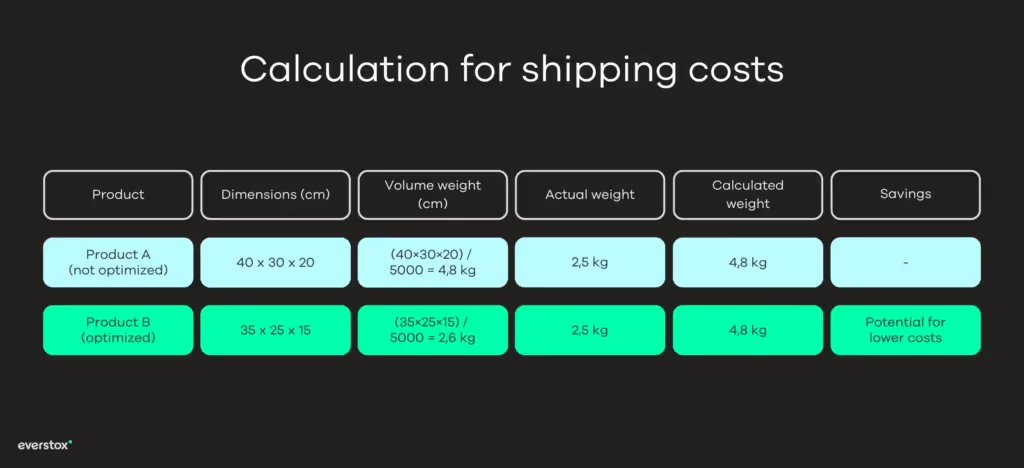
Potential: if you undercut the dimensional weight tier, savings of up to 30–45% are possible in individual cases, depending on tariff and zone structure. This directly affects your company’s return on investment.
Audit your current shipping contracts and processes
Critically review your current contracts with shipping service providers: do the terms still match your shipping volume? Are there surcharges for certain zones or parcel sizes that you could avoid?
Document your processes from goods receipt to last-mile delivery to make bottlenecks and time sinks visible. Optimized shipping execution through digitization and automation, for example with a warehouse management system (WMS), increases efficiency – the key is proper integration into your administration and operational workflows.
Quick wins: 5 immediate actions to reduce your shipping costs
Some levers deliver fast results. Here are 5 immediate actions to get you moving right away:
1. Optimize packaging: lighter, smaller, cheaper
Every centimeter and every gram counts. Use the smallest possible carton size for your products. The right packing method not only saves material, but also reduces dimensional weight and thus your shipping costs. In some cases, the right packaging is the key to preventing transport damage. Keep 3-5 optimally matched carton sizes and suitable void fill materials on hand to minimize empty space and standardize processes.
2. Use shipping rates intelligently
Log in to your carrier’s business customer portal. You’ll often find untapped possibilities there, such as special rates for certain parcel sizes, shipping flatrates, or discounted offers for high-volume shippers. Regularly compare the offers of different shipping service providers to obtain better prices, and check whether you can negotiate discounts or individualized agreements.
Note: your monthly shipping volume significantly influences the pricing structure. Shipping consolidators bundle shipping volumes and thus enable access to attractive rates and flexible possibilities to send parcels.
3. Review shipping insurance: insure only what’s necessary
Parcels are typically insured up to a certain amount by default (for many national parcel products, e.g., €500). Check per product and carrier whether additional insurance is really necessary. Standard liability varies by service – and for lower item values, the savings from reduced insurance fees can be substantial.
4. Minimize return costs
Returns remain one of the biggest cost drivers in online retail. Transparent returns handling strengthens customer satisfaction and reduces process costs. Avoid unclear return instructions, incorrect addresses, or incomplete shipping labels – this saves time and effort. Consolidating multiple orders into one parcel can reduce shipping and handling costs.
Also focus on:
- Accurate product descriptions: detailed text, images, and videos reduce misbuys.
- Size charts and fit guides: especially important in fashion.
- Customer reviews: authentic feedback supports purchase decisions and strengthens your customers’ trust.
- Quality control: only flawless goods should leave the warehouse.
5. Free shipping: when it pays off
Free shipping is a powerful conversion lever – but it’s never truly free. Use it strategically, for example via minimum order values, regional shipping options, or a shipping flatrate. For companies with B2B and D2C mixed models, a channel-specific shipping cost model is advisable to keep margins realistic.
Free shipping from a certain order value can increase the average basket, while a fair flat shipping fee creates transparency. An A/B test for each channel shows which option works in your customer segment.
Long-term strategies for sustainable savings
For lasting savings, you need more than quick wins: a strategy. Rely on automation, data-driven inventory management, and the right location structure. This way, you permanently reduce shipping and storage costs, optimize your shipping processes, and remain scalable – regardless of market volume and your customers’ demand.
Negotiate like a pro: step-by-step guide for talks with DHL, DPD & Co.
Yes, shipping prices are negotiable – with the right preparation:
Collect data: know your shipping volume, average parcel sizes, and main regions.
Obtain offers: get comparison quotes from DPD, GLS & co. to strengthen your position.
Set up a meeting: ask your contact for a targeted optimization discussion.
Make your case: present data, alternatives, and your growth potential.
Lock it in: have new terms confirmed in writing.
The multi-carrier strategy: finding the right provider mix
Why put all your eggs in one basket? A multi-carrier strategy lets you automatically select the best shipping service provider depending on parcel size, weight, or destination. This reduces shipping costs, increases flexibility, and ensures punctual pickup and delivery.
A modern shipping software with API connection to your shop system (e.g., Shopify) automates this process and integrates tracking and reporting. This ensures you always use the optimal rate and have full transparency at all times.
Outsource logistics – smart, fast, scalable
With everstox as a fulfillment-as-a-service partner, you gain access to a vetted network of professional shipping service providers and fulfillment partners – and save costs, time, and hassle without becoming a logistics company yourself.
Benefits:
Lower costs: by bundling volumes within the everstox network, better purchasing and shipping conditions can be achieved.
Scalability: you can grow flexibly without investing in your own warehouses or staff.
Expertise & technology: you benefit from optimized processes, tracking, and real-time transparency across all locations.
International shipping: saving on duties and taxes
Cross-border shipping brings new challenges. To avoid delays and additional costs, correct and complete customs documentation is essential.
Postal shipments: CN22/CN23 forms
Courier services (e.g., DHL Express, UPS): electronic commercial invoices and customs data
Note: requirements vary by destination country, goods value, and product.
A fulfillment partner with cross-border expertise like everstox ensures smooth processes – from customs preparation to delivery and optional pickup via regional parcel services.
Fulfillment (3PL) vs. in-house: an honest cost-benefit analysis
At a certain stage of growth, the question arises: do it yourself or outsource?
A fulfillment-as-a-service provider like everstox combines the advantages of multiple 3PLs on a single platform.
Through the everstox network, vetted fulfillment partners handle storage, picking, packing, shipping, and pallet logistics – including digital transparency and tracking across all locations.
Reduce shipping costs smartly with everstox
If you want to set up your logistics efficiently and scalably, everstox is the right partner at your side. With our logistics-as-a-service model you benefit from:
- a Europe-wide network of warehouse locations (multi-warehousing)
- intelligent carrier management for the most economical shipping rate (multi-carrier)
- a software solution that makes all processes transparent – from order to delivery
Whether you want to grow internationally or improve your margin: with everstox you’ll take your logistics to the next level – without additional operational workload.
Frequently asked questions
Which parcel service is cheapest for small businesses?
How do I measure the ROI of shipping cost optimization?
Do I have to comply with the Packaging Act (VerpackG)?
About the author

Anna Kraus
eCommerce and logistics expert
With over seven years of experience in online marketing, Anna is responsible for the content strategy and editorial development of the everstox website. Her work focuses on eCommerce, logistics, and supply chain management, translating complex operational topics into clear, relevant, and actionable insights.
Since joining everstox in 2024, Anna has taken full ownership of the company’s editorial content, including blog articles, in-depth industry pieces, and the complete everstox glossary. Her content connects current trends in eCommerce and logistics with the real-world challenges faced by growing brands, helping decision-makers navigate an increasingly complex operational landscape.
Anna holds a bachelor’s degree from the University of Salzburg and earned a Master of Business Administration with a focus on health management from IU International University. Her master’s thesis on occupational health management reflects her analytical mindset and her interest in how integrated strategies can strengthen long-term business performance.
By combining academic rigor with hands-on marketing experience, Anna delivers content that goes beyond surface-level commentary. Her work offers readers a clear, well-informed perspective on the intersection of digital innovation, logistics, and supply chain operations, with a strong focus on practical relevance and strategic clarity.
More growth, less effort.
Scale fulfillment, shipping, and warehousing with a platform that brings everything together.
More interesting articles

Customs documents: how to avoid delays and in international trade
Your goods are packed, the carrier is booked, and the customer abroad is waiting for delivery – and suddenly everything comes to a halt. The reason: the shipment gets stuck in customs clearance. For eCommerce merchants and fulfillment providers, this is a worst-case scenario. It means delivery delays, unexpected storage fees, penalties, and frustrated customers.
The good news: many of these risks can be avoided with clear processes and complete customs documents – especially when all required documents are fully prepared and accurate.
This guide gives you a practical overview of which documents matter for export, how to avoid errors on the commercial invoice, and how automated customs declarations make your international growth scalable – from understanding liabilities to digital process optimization. Clean customs documentation is crucial in every section of the workflow, across any operational area.
Mastering seasonal peaks: how multi-warehousing helps prevent bottlenecks
Your marketing campaigns for Black Friday or the holiday season are running at full speed, the servers handle the traffic, orders skyrocket – and then everything stops. Not in your shop, but in the warehouse. When parcels remain stuck, throughput times explode and customers wait for their orders, the “logistics blackout” becomes reality.
A single warehouse location quickly turns into a “single point of failure” during peak season fulfillment. The solution for growing eCommerce and online retailers isn’t a bigger central warehouse, but flexibility: a strategy built on multi-warehousing.
This article shows you why decentralized warehousing has become essential in modern eCommerce. We break down the hidden risks of centralization, highlight the strategic advantages of a multi-warehousing setup and offer a clear guide on how to elevate your inventory management through automation and the right partner network.

Online marketplaces in Germany: opportunities for retailers and brands
Online marketplaces are digital platforms where multiple sellers offer their products, giving customers a wide selection. However, rising competition, high fees, and stricter quality requirements mean that sellers need a clear marketplace strategy and strong fulfillment partners to succeed.