

Fulfillment center vs. warehouse: make the right choice for your company
3/5/2025

What is a fulfillment center?
A fulfillment center is a central logistics hub that supports your company in efficiently storing, processing and shipping orders directly to your customers. It covers the entire order fulfillment process and ensures fast and precise deliveries.
Typical tasks of a fulfillment center:
• Goods receiving and inspection: receipt of incoming goods, quality control and stocktaking.
• Storage: temporary, structured storage of products, ready for delivery.
• Picking and packing: compiling orders, secure packaging and labeling.
• Shipping organization: cooperation with shipping service providers such as DHL or UPS for punctual deliveries.
• Returns management: efficient processing and restocking of returned items.
• Real-time inventory management: use of modern software for transparency and process control.
These versatile processes make fulfillment centers a crucial component of modern supply chains and eCommerce strategies.
Benefits for your business:
• Time savings: freeing up internal resources and more focus on the core business.
• Scalability: flexible adaptation to seasonal demand or company growth.
• Cost efficiency: optimized processes and lower shipping rates thanks to volume bundling.
• Customer satisfaction: faster delivery times and professional returns management improve the shopping experience.
• Technology integration: efficient processes through real-time tracking and automated workflows.
Fulfillment centers are therefore not just a place of storage, but also the key to a flexible and customer-oriented logistics solution.
What is a warehouse?
A warehouse is a storage area for the long-term storage of goods and products. It is primarily used to safely store large quantities of inventory until they are needed for further transportation or sale. In contrast to a fulfillment center, a warehouse is primarily designed for static storage.
Typical tasks of a warehouse:
• Storage of goods: long-term storage of products, often for months or years.
• Inventory management: management and organization of stock, including accounting and tracking.
• Incoming goods: checking and storing new deliveries.
• Outgoing goods: preparation and loading of goods for transportation to other locations.
• Special warehouse types: temperature-controlled storage or automated systems for specific requirements.
Warehouses are often designed for stability and large volumes, with less dynamic processes compared to fulfillment centers.
Benefits for your business:
• Cost-efficient storage: ideal for storing large quantities of products at comparatively low cost.
• Long-term planning: perfect for your business if you need to store seasonal or surplus stock.
• Safety precautions: Protection of goods through advanced security systems and monitoring.
• Supply chain flexibility: ability to store products centrally or in strategic locations.
• Integration into B2B processes: Support for wholesale, manufacturing or distribution.
Warehouses play an important role in the supply chain, especially if your company is looking for a stable storage solution for large quantities of goods. They are the basis for long-term storage and efficient inventory management.
The differences between fulfillment centers and warehouses
Fulfillment centers and warehouses have similarities at first glance, but fulfill different functions in the supply chain. While a fulfillment center is geared towards fast order processing, a warehouse focuses on long-term storage. Here are the most important differences:
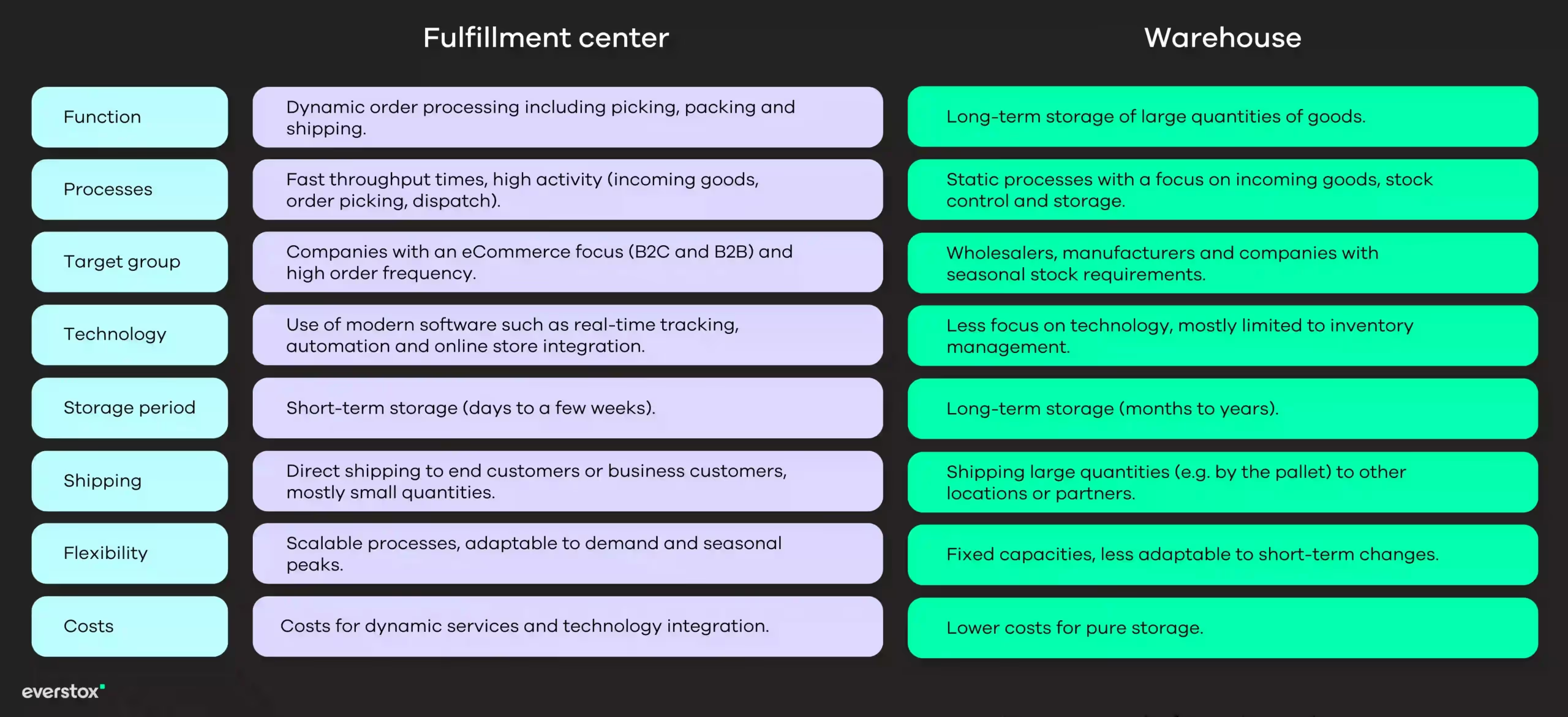
While fulfillment centers are designed for fast and customer-oriented processes, warehouses offer a cost-efficient solution for storing large quantities.
Additional services of fulfillment centers
Fulfillment centers offer far more than just the handling of standard logistics processes. With a variety of additional services, they enable your company to make logistics more efficient, save costs and increase your customer satisfaction. These services are particularly beneficial for growing companies and eCommerce providers.
Kitting and bundling:
• Combining several products into one package (e.g. subscriptions or gift boxes).
• Reduce shipping costs with consolidated shipments.
• Perfect for subscription box companies or promotions.
Cross-docking:
• Direct forwarding of incoming goods to B2C or B2B shipping without having to store them.
• Significantly shortens delivery times as warehouse processes are skipped.
• Ideal for products with high demand or backorder processing.
Returns management:
• Efficient processing of returns, including inspection and restocking.
• Fast processing of refunds improves customer satisfaction.
• Reduction of storage costs through reprocessing of returned products.
Location advantages and shipping optimization:
• Strategically located fulfillment centers enable faster delivery to customers.
• Optimization of shipping zones reduces transport times and costs.
• Support from national and international networks for cross-border shipping.
Use of modern technology:
• Use of real-time tracking systems for inventory monitoring.
• Integration with eCommerce platforms (e.g. Shopify, Amazon) for seamless processes.
• Automation of processes for greater efficiency and scalability.
Why fulfillment centers are crucial for eCommerce
Fulfillment centers are indispensable for eCommerce as they offer fast and efficient logistics solutions. They allow your company to focus on its core business while processes such as picking, packing and shipping are handled professionally. Strategically located sites ensure shorter delivery times and reduce shipping costs.
Modern technologies such as real-time tracking and automated processes increase efficiency and transparency. Fulfillment centers also offer you flexible solutions to cope with seasonal peaks in demand and growth. Thanks to optimized processes and sustainable logistics, they not only help to reduce costs, but also increase customer satisfaction – a decisive factor in the competitive online retail sector.
Conclusion: fulfillment center vs. warehouse
Fulfillment centers and warehouses fulfil different functions in logistics and should be used in a targeted manner depending on the business model. While warehouses are suitable for the long-term storage of large quantities, fulfillment centers impress with fast, efficient processes that are specifically tailored to the needs of eCommerce. They offer flexible solutions to cope with seasonal peaks and growth and use state-of-the-art technologies such as real-time tracking to increase your customer satisfaction.
Your business will benefit from shorter delivery times, optimized costs and a sustainable approach. The decision between the two options depends on individual requirements – but fulfillment centers are particularly indispensable for dynamic, customer-oriented business models.
Frequently asked questions
Why should eCommerce retailers use a fulfillment service provider?
What distinguishes a fulfillment center from a traditional warehouse?
How does a fulfillment service provider support the shipping process?
About the author

Anna Kraus
eCommerce and logistics expert
With over seven years of experience in online marketing, Anna is responsible for the content strategy and editorial development of the everstox website. Her work focuses on eCommerce, logistics, and supply chain management, translating complex operational topics into clear, relevant, and actionable insights.
Since joining everstox in 2024, Anna has taken full ownership of the company’s editorial content, including blog articles, in-depth industry pieces, and the complete everstox glossary. Her content connects current trends in eCommerce and logistics with the real-world challenges faced by growing brands, helping decision-makers navigate an increasingly complex operational landscape.
Anna holds a bachelor’s degree from the University of Salzburg and earned a Master of Business Administration with a focus on health management from IU International University. Her master’s thesis on occupational health management reflects her analytical mindset and her interest in how integrated strategies can strengthen long-term business performance.
By combining academic rigor with hands-on marketing experience, Anna delivers content that goes beyond surface-level commentary. Her work offers readers a clear, well-informed perspective on the intersection of digital innovation, logistics, and supply chain operations, with a strong focus on practical relevance and strategic clarity.
More growth, less effort.
Scale fulfillment, shipping, and warehousing with a platform that brings everything together.
More interesting articles

Customs documents: how to avoid delays and in international trade
Your goods are packed, the carrier is booked, and the customer abroad is waiting for delivery – and suddenly everything comes to a halt. The reason: the shipment gets stuck in customs clearance. For eCommerce merchants and fulfillment providers, this is a worst-case scenario. It means delivery delays, unexpected storage fees, penalties, and frustrated customers.
The good news: many of these risks can be avoided with clear processes and complete customs documents – especially when all required documents are fully prepared and accurate.
This guide gives you a practical overview of which documents matter for export, how to avoid errors on the commercial invoice, and how automated customs declarations make your international growth scalable – from understanding liabilities to digital process optimization. Clean customs documentation is crucial in every section of the workflow, across any operational area.
Mastering seasonal peaks: how multi-warehousing helps prevent bottlenecks
Your marketing campaigns for Black Friday or the holiday season are running at full speed, the servers handle the traffic, orders skyrocket – and then everything stops. Not in your shop, but in the warehouse. When parcels remain stuck, throughput times explode and customers wait for their orders, the “logistics blackout” becomes reality.
A single warehouse location quickly turns into a “single point of failure” during peak season fulfillment. The solution for growing eCommerce and online retailers isn’t a bigger central warehouse, but flexibility: a strategy built on multi-warehousing.
This article shows you why decentralized warehousing has become essential in modern eCommerce. We break down the hidden risks of centralization, highlight the strategic advantages of a multi-warehousing setup and offer a clear guide on how to elevate your inventory management through automation and the right partner network.

Online marketplaces in Germany: opportunities for retailers and brands
Online marketplaces are digital platforms where multiple sellers offer their products, giving customers a wide selection. However, rising competition, high fees, and stricter quality requirements mean that sellers need a clear marketplace strategy and strong fulfillment partners to succeed.