

6 tips to reduce logistics costs in 2025
1/6/2025

Our logistics cost insights in a nutshell
Reducing warehousing, fulfillment, and shipping costs will be the top priority for every eCommerce business’ CFO and COO this year.
However, a challenge for one business is an opportunity for another. What it takes to take this opportunity is a clear view of the logistics market including providers, services, price levels as well as a well-rounded supply chain strategy to reduce logistics costs. So eCommerce businesses will not have to sacrifice service quality or customer experience no more.
In this article, we’ll provide all the required answers to supercharge your logistics for bigger cost savings and more efficiency.
How to reduce logistics costs in 2025?
Our ultimate eCommerce guide
Our findings and recommendations are based on comprehensive research from institutions like McKinsey, Bloomberg and OECD paired with practical insights into the everstox database, which combines over 1000 quotes of warehousing, fulfillment, and shipping rates for different eCommerce companies and target markets. Plus, we’ll comment along the way with first-hand operators’ insights including João Martins, CFO at HeyHarper, and Johannes Tress and Boris Bösch, Co-CEOs at everstox.

Boris Bösch, Co-Founder & Co-CEO at everstox, João Martins, CFO at Hey Harper, and Johannes Tress, Co-Founder & Co-CEO at everstox.
We expect 2025 to be a challenging year for eCommerce businesses and logistics providers like 3PLs and Carriers. Cost pressure for eCommerce decision makers will face high cost structures of providers. This could lead to a very unhealthy negotiation cycle sacrificing service quality and customer experience for costs. At everstox, we’ll avoid this by delivering network optimization and software solutions to increase efficiency and reduce costs for both.
Logistics costs insights from Boris Bösch, Co-CEO at everstox
Reducing costs without losing operational excellence? That’s possible. Simply benchmark your current spend to the everstox database with warehousing, fulfillment and shipping rates from >1,000 quotes for different eCom use cases and target markets. Our beneficial rates enable your business to reduce logistics costs in 2025.
Direct logistics costs vs. total logistics costs definition
Understanding types of logistics costs
Given the uncertainty in the market, it’s very reasonable to focus on efficiency and cost reductions of the eCommerce business and thus within logistics, making up about 20% of eCommerce sales. Also, it’s key to look at total logistics costs instead of only at the direct logistics costs since we know that logistics plays a huge role in customer experience and overall eCommerce operations efficiency.
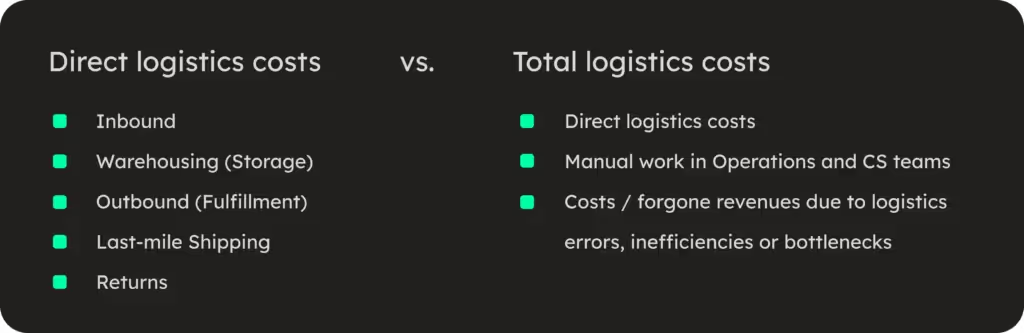
Definition: what are logistics costs?
Direct logistics costs are referred to as rates for freight, warehousing, fulfillment, and shipping. Essentially, the pricing and invoices received from 3PLs and carriers when outsourcing logistics or the comparable direct costs when managing in-house logistics.
Meanwhile, total logistics costs go beyond what we mentioned above. They also include manual work that requires managing day-to-day operations (e.g. operations and customer service team costs) and all indirect costs resulting from lack of service quality (e.g. higher return rates, lower repurchase rates, etc.)
The difference between total logistics costs and direct logistics costs is particularly important. That is, reducing direct costs does not necessarily lower the total logistics costs. Lowest-cost fulfillment service or carrier service providers often don’t excel in service quality and precision, which derives additional internal manual work and also threatens the customer experience. Instead of blindly aiming for the lowest-cost procurement rates, CFOs and COOs could try to optimize total logistics costs.
Managing total logistics costs and operational efficiency is key for us in 2025. However, we prioritize those initiatives that generate logistics savings and improve our customer experience at the same time. E.g. local fulfillment centers in Europe, the UK and the US and a dynamic multi-carrier-selection with everstox help us to reduce shipping costs while offering a faster and more reliable delivery to our customers.
Logistics costs insights from João Martins, CFO at Hey Harper
What will happen to direct logistics costs in 2025?
Understanding current logistics prices
In 2025, direct logistics costs are expected to increase due to factors such as labor shortages, rising fuel prices, and supply chain challenges. Labor shortages, especially in areas like drivers and warehouse workers, will continue to push wages higher, raising overall logistics expenses. Automation can help mitigate this, but it requires significant upfront investment.
At the same time, transportation costs will rise due to higher energy prices, driven by geopolitical tensions and environmental regulations. The use of logistics software for automation, real-time tracking, and route optimization can reduce costs but comes with initial setup expenses. Additionally, cross-border logistics may become more expensive due to regulatory changes, pushing companies to rely more on regional logistics hubs.
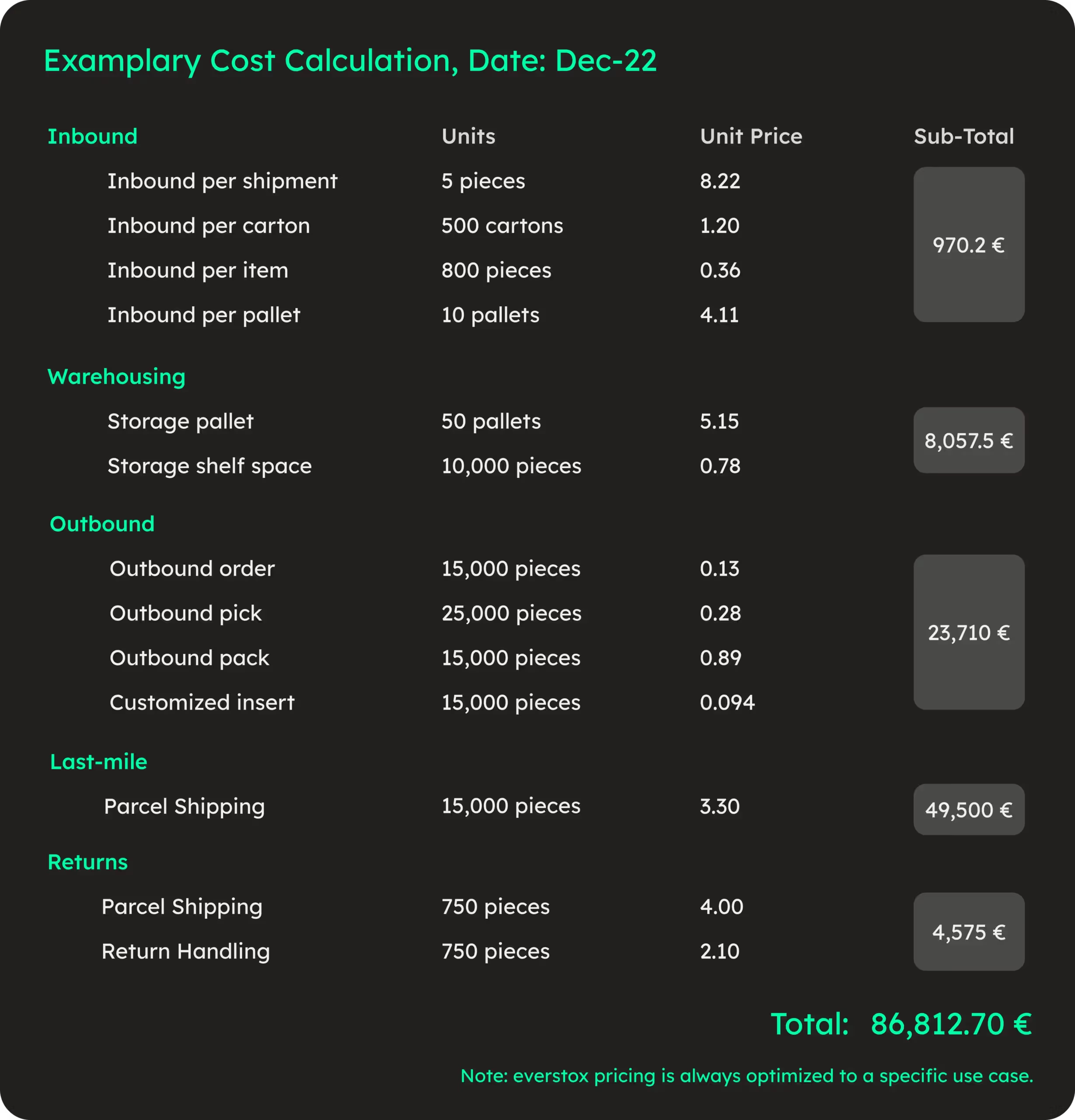
Logistics service price increases inherit a time lag due to contract structures. Most contracts include annual price reviews that will come up throughout the year for eCommerce businesses. Any eCommerce decision maker should review their set-up now to avoid being surprised by a cost increase in 2025.
Logistics costs insights from Johannes Tress, Co-CEO at everstox
What are the drivers behind increasing direct logistics costs?
The drivers behind increasing logistics costs are systemic and will hit every eCommerce brand and operational 3PL or carrier equally. In order to better understand how to reduce logistics costs, we take a closer look at all cost categories. We separate the inbound and warehousing, outbound and fulfillment rates, and last-mile shipping rates in more detail below.
Inbound, warehousing, outbound and fulfillment costs 2025
Rising warehouse labor costs are a key element of increased warehouse & fulfillment costs, with year-on-year wage growth running in excess of 20% over the last two years in the US. This has risen from a 5% to 10% range from 2000 to 2015. Similar trends can also be found across Europe. For example, the minimum wage has risen in Germany and the overall shortage of warehouse labor increases labor rates.
Warehouse labor costs should mainly impact processing rates including inbounding, pick&pack, return handling, etc. Therefore, a high standard of intralogistics automation will be key. We expect storage rates to be more stable. Many 3PLs & eCommerce businesses invested in warehouse space over the last years which is now, given the recent market slowdown, available at good rates.
The increased energy costs also put pressure on warehousing and fulfillment costs due to the expenses on essentials like lighting, temperature control, intralogistics automation and similar facilities. Additionally, resource costs such as wood for pallets or paper for cartons and filling materials have already been increasing significantly in the last years with likely further increases in 2025.
Last-mile delivery – carrier and shipping costs 2025
Besides labor shortage and energy costs, overall inflation over the last few years has also been the key driver behind increasing carrier and shipping costs. All major carriers including DHL, UPS, and FedEx had significant price increases between 6.9% to 7.9% in the last years indicating the direction for overall market levels.
Looking at the overall dynamics of direct logistics costs, I’d recommend a CFO to put optimization of carrier and shipping costs on top of their agenda. E.g. in Germany given a domestic parcel rate of ca. €3 / international parcel rate of ca. €6, a 10% cost increase / optimization delivers €0.30ct to €0.60ct in savings potential. This is very hard to squeeze out of €1 to €2 avg. total fulfillment costs / order with thin margins.
Logistics costs insights from Boris Bösch, Co-CEO at everstox
6 pro-tips on how to reduce logistics costs in 2025
Given the trade-off between direct logistics costs and total logistics costs, we’re focusing on 6 key tips that will help you to optimize your total logistics costs without sacrificing, potentially even improving, customer experience and logistics quality.
Benchmark your current logistics costs and identify savings potentials
Tip #1 to reduce logistics costs
Logistics is a thin-margin business. It’s impossible to negotiate cost savings when you’re already paying fair market rates for quality services without sacrificing heavily on indirect logistics costs. It’s key to benchmark your costs and to identify the right cost buckets where you’re potentially overpaying because of your overall supply chain set-up and design.
Also, you should spend your time and efforts on cost optimization on the right things. everstox can support you on this exercise with a database of >1,000 quotes for warehousing & fulfillment services in different products & markets and negotiated carrier rates with all major carriers incl. DHL, UPS, FedEx, etc.
everstox helped us reduce our direct logistics cost by 20-30% compared to standard market offerings. What’s more, we now expanded to 4 additional markets with 4 local warehouses and fulfillment solutions managed, monitored and coordinated with only 1 integrated platform. Thanks to everstox, we can easily track inventory flows, act quickly to avoid stock disruptions and at the same time reduce overhead for our operational team. In short: we are able to drastically reduce indirect costs to manage operations, even though we scaled our sales 5 times.
Logistics costs insights from João Martins, CFO at Hey Harper
Use a specialized 3PL
Tip #2 to reduce logistics costs
Work with a specialized 3PL that already understands your product and processes and serves within the warehouse already similar projects. By doing so, businesses can reduce fixed costs and overall fulfillment costs from 3PL’s expertise in every market scenario. According to McKinsey, specialized fulfillment drives cost savings of 7-9% in comparison to mainstream fulfillment.
And it seems like they are more attractive to eCommerce businesses than ever. If you fit well into already established 3PL processes for other customers, you can benefit from their economies of scale and get access to attractive rates. 3PLs usually can afford to invest more in warehouse automation across their customer base, particularly important in light of increasing warehouse labor costs.
Given the current market environment, most eCommerce businesses will probably run below forecasts and thus 3PLs mostly (over)invested in capacities recently. The market timing in early 2025 will be good for eCommerce businesses to get access to attractive rates if they identify the perfectly fitting 3PL capacities.
Logistics costs insights from Johannes Tress, Co-CEO at everstox
Optimize carrier costs and select dynamic shipping methods
Tip #3 to reduce logistics costs
Working with a partner like everstox that bundles a high amount of parcel volumes across their customer base can grant access to better rates through scale effects for the same carrier service levels. Also, everstox enables merchants of all sizes to follow a multi-carrier approach. There is no universal best-performing and most cost-efficient carrier, hence leading brands work with multiple partners for different product categories, target markets and service levels (e.g. Zalando has 38 parcel carriers across all markets).
Within this multi-carrier set up a tech-driven dynamic carrier selection can be applied to optimize costs by product categories and target markets. E.g. everstox software enables you to intelligently choose the most cost-efficient solution between leading carriers like DHL, GLS, UPS, or FedEx for every order depending on parcel weight, dimension and destination.
Optimize your fulfillment center footprint and use multi-warehousing
Tip #4 to reduce logistics costs
Many eCommerce businesses are significantly overpaying for logistics because of structural reasons in their logistics footprint. Often the main reason for the location of their main fulfillment center is that it’s close to their HQ vs. optimization for logistics costs.
Oftentimes, there’s significant savings potential in choosing a location that is optimizing the equation between distance to production and main order destinations. Plus, e.g. in light of minimum wage increases close-to-border locations in Eastern Europe are often a chance to reduce logistics costs.
Depending on the order structure, decentralizing fulfillment to multiple local warehouses often generates huge cost savings in carrier and shipping costs.
Reduce manual work in day-to-day operations
Tip #5 to reduce logistics costs
Rising direct logistics costs can (partly) be offset with driving automation and reducing unnecessary manual work and labor across day-to-day operations.
This requires optimizing efficiency in day-to-day interaction between your customer service, operations team and your warehousing, fulfillment and shipping operations.
Thanks to the everstox technology, automation and digital workflows, we’ve been able to expand to multiple warehouse locations across Europe, the UK and the US and to multiple carrier service offerings including DHL, Warenpost, DHL Express, UPS or FedEx while keeping our workload in operations and customer service teams at efficient levels.
Logistics costs insights from João Martins, CFO at Hey Harper
Run detailed cost audits
Tip #6 to reduce logistics costs
Stay in control of all your costs and pay for what you really get. Particularly carrier invoices can often be very intransparent with thousands of orders every month with different dimensions, weight categories, destinations, and various surcharges. It is very common that eCommerce businesses are overbilled by service providers without notice.
However, it’s also impossible to review every invoice and every parcel sent line by line. It’s key to develop automated cost audit processes to stay on top of your expenses and within your budget. For example, everstox provides parcel audit services for all everstox shipping offerings to ensure customers that they only pay for what they get.
everstox identifies significant cost claims on almost every carrier invoice. It’s a huge cost and time saving for us that we don’t have to do those cost audits ourselves.
Logistics costs insights from João Martins, CFO at Hey Harper
Key takeaways – optimizing logistics costs in 2025
To be clear, 2025 will be a challenging year for eCommerce business CFOs and COOs. Keeping total logistics costs under control, while direct logistics costs around warehousing, fulfillment and shipping will likely increase at double-digit rates, and still delivering on customer experience is a huge mountain to climb.
Thus, it’s key to benchmark your current logistics setup and identify the right initiatives to optimize your setup now. This guide and our 6 pro tips will be the right starting point. If you wish for more support, the everstox team will be happy to assist. Simply get started with our beneficial rates and reduce logistics costs in 2025.
We are strongly convinced that we’ll continue our recent growth success story in 2025. We believe that operational and logistics efficiency will be a key competitive advantage to do so.
Logistics costs insights from João Martins, CFO at Hey Harper
Frequently asked questions
About the author

Kristina Mertens
Expert in eCommerce & Digital Marketing
With a strong academic background and over eight years of experience in eCommerce and digital marketing, Kristina Mertens is a recognized expert in online retail and marketing strategies. She has been leading marketing activities at everstox since November 2023.
Her academic qualifications include a B.Sc. in Global Business Management from the University of Augsburg and an M.Sc. in Marketing & Communication from the FOM University of Applied Sciences for Economics & Management.
As part of her master's thesis, she examined the influence of social media features on the usage behavior of streaming platform subscribers.
As a (guest) author, Kristina Mertens regularly publishes specialist articles in renowned media such as t3n magazine and on various industry platforms. Her core competencies include e-commerce, logistics & fulfillment, last-mile delivery, and social commerce, enabling her to offer in-depth insights into current developments in the digital (platform) economy.
More growth, less effort.
Scale fulfillment, shipping, and warehousing with a platform that brings everything together.
More interesting articles

Customs documents: how to avoid delays and in international trade
Your goods are packed, the carrier is booked, and the customer abroad is waiting for delivery – and suddenly everything comes to a halt. The reason: the shipment gets stuck in customs clearance. For eCommerce merchants and fulfillment providers, this is a worst-case scenario. It means delivery delays, unexpected storage fees, penalties, and frustrated customers.
The good news: many of these risks can be avoided with clear processes and complete customs documents – especially when all required documents are fully prepared and accurate.
This guide gives you a practical overview of which documents matter for export, how to avoid errors on the commercial invoice, and how automated customs declarations make your international growth scalable – from understanding liabilities to digital process optimization. Clean customs documentation is crucial in every section of the workflow, across any operational area.

Mastering seasonal peaks: how multi-warehousing helps prevent bottlenecks
Your marketing campaigns for Black Friday or the holiday season are running at full speed, the servers handle the traffic, orders skyrocket – and then everything stops. Not in your shop, but in the warehouse. When parcels remain stuck, throughput times explode and customers wait for their orders, the “logistics blackout” becomes reality.
A single warehouse location quickly turns into a “single point of failure” during peak season fulfillment. The solution for growing eCommerce and online retailers isn’t a bigger central warehouse, but flexibility: a strategy built on multi-warehousing.
This article shows you why decentralized warehousing has become essential in modern eCommerce. We break down the hidden risks of centralization, highlight the strategic advantages of a multi-warehousing setup and offer a clear guide on how to elevate your inventory management through automation and the right partner network.

Online marketplaces in Germany: opportunities for retailers and brands
Online marketplaces are digital platforms where multiple sellers offer their products, giving customers a wide selection. However, rising competition, high fees, and stricter quality requirements mean that sellers need a clear marketplace strategy and strong fulfillment partners to succeed.