

Optimizing warehouse management: the ultimate guide for online shops 2025
11/14/2025

Efficient warehouse processes are not a “nice-to-have”, but the backbone of your eCommerce success. Optimized warehouse management directly lowers your costs, increases customer satisfaction through fast deliveries, and secures the scalability of your business. If you want to grow, you can’t avoid this topic. So: where do you start?
This guide gives you not only the theoretical foundations, but also practical strategies and technological levers to sustainably optimize your warehouse processes – from chaotic warehousing to a multi-warehouse strategy. Get the best tips for your efficient warehouse.
What is warehouse optimization?
Warehouse optimization is the strategic and continuous adjustment of all physical and information-based processes within intralogistics. The primary goal is to reduce total cost per warehouse movement (handling cost).
It’s not just about pure cost savings, but primarily about maximizing service level, speed, and error-free execution. At its core, optimization uses the three critical resources – storage space, tied-up capital, and personnel time – in the best possible ratio. Successful warehouse optimization creates direct added value for the end customer (faster delivery) and is the prerequisite for a scalable logistics infrastructure that supports your eCommerce growth efficiently. In doing so, you optimize the entire flow of goods in your warehouse.
Why optimizing your warehouse processes is crucial
Rising customer expectations around delivery speed and competitive pressure turn inefficient intralogistics into an expensive trap. Every minute lost during picking, every incorrectly stored item, and every delayed delivery costs you money and trust, increases service effort and can raise return risks. Strategic optimization of your processes transforms your warehouse from a pure cost center into a real competitive advantage. It’s about becoming faster, more accurate, and more flexible – exactly what customers expect today and what defines efficient warehouse management. The increased productivity is therefore a key factor in operations.
Analyzing your warehouse – where do your costs really stand?
Before you change processes, you need a clear data foundation. Optimizing blindly is like traveling without a map. Start by understanding your current workflows and KPIs so you can systematically reduce warehouse costs. Take enough time to carefully search for bottlenecks.
Which KPIs are important for warehouse logistics?
To objectively measure your performance, key performance indicators (KPIs) are essential. Focus on the most important metrics to avoid losing the overview. These include:
Inventory turnover
How often are your total inventory levels sold and replaced in a given period? A high value indicates fast-moving products and low capital lock-up.
Throughput time
How long does it take from order receipt or goods receipt to shipping to the customer? Shorter times (time-to-ship) mean more satisfied customers.
Picking time per order
The pure time needed to collect the items for an order. This is the most direct indicator of how efficient your warehouse layout and picking strategy are.
Picking error rate
How many orders are picked incorrectly (wrong item, wrong quantity)? Every error generates high costs for returns and reshipments.
Tied-up capital in inventory
The total value of the goods you store – a critical KPI, because high capital commitment restricts liquidity. This is especially important for brands aiming to scale quickly: optimized inventory levels reduce financial pressure and free up resources for growth. Platform features such as real-time stock visibility, batch tracking, and dynamic inventory calculations support this level of transparency.
How ABC analysis steers your inventory management
Not all products are equally important. ABC analysis helps you classify items based on their value contribution and thus optimize storage:
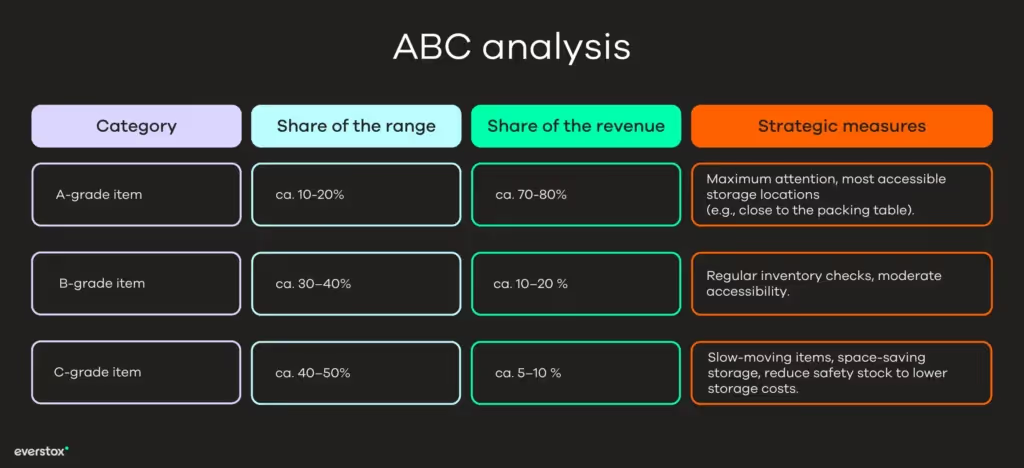
This analysis is the foundation for efficient warehousing and inventory management as well as an optimized warehouse layout (keyword: route minimization). The percentages are guidelines and can vary by industry and assortment breadth.
What are the 5 tasks of warehouse management?
Once you know your data, you can systematically tackle the following five warehouse areas to optimize your warehouse processes.
1. Inventory management: how to plan with FIFO, safety stock & forecasts
Precise inventory optimization prevents out-of-stock situations and excess stock.
FIFO method
Use the first-in-first-out method to ensure that older goods are sold first (important for perishable or time-sensitive products).
Dynamic safety stock
Define dynamic safety stock based on forecasts, target service level, and the lead time / delivery reliability of your supply chain. This prevents buffers that unnecessarily tie up capital.
2. Warehouse layout & organization: how the right system saves walking distances
Short distances save time and money. Review your warehouse layout critically.
Chaotic warehousing
For many eCommerce companies with frequently changing assortments, chaotic warehousing (also called dynamic storage) is particularly useful. Every item is stored in any free location and recorded in the warehouse management system (WMS), provided a location-accurate slot management is active and all bookings are made in real time. The result: maximum use of storage space and flexible putaway.
Route optimization
Based on the ABC analysis, your A-items should be placed on the shortest routes to the packing station. Use picking routes optimized for your operation (e.g. serial or zone picking).
3. Picking: how to avoid errors and increase speed
Picking is one of the most labor-intensive processes.
Pick-by-Scan/Voice
The use of handheld scanners (pick-by-scan) or voice-guided systems (pick-by-voice) reduces manual sources of error and makes paper pick lists obsolete. Digital pick lists via a WMS drastically reduce picking errors and speed up the process. At the same time, warehouse staff are noticeably relieved.
Batch picking
Combine several small orders into a single picking run to bundle walking distances and significantly increase efficiency at high order volumes.
4. Returns management: how to use returns as a competitive advantage
Optimized returns management is crucial because it directly affects inventory turnover.
Ensure that returned goods are checked, assessed, and either restocked or written off / reconditioned as quickly as possible. This avoids valuable products blocking storage space without being used.
For international shipping (e.g. to the USA), a local returns hub can be the smartest solution to save costs and time.
5. Packaging & shipping: how to save costs and time
The interface between warehouse and shipping is the final crucial lever.
Packaging standards
Keep a selection of 3 to 5 optimal carton sizes to minimize empty space and filler material (reduction of volumetric weight). This optimizes the required material.
Multi-carrier strategy
A carrier management system (CMS) assigns the appropriate carrier to each parcel based on rules and, depending on the setup, also considers targets such as cost, transit time, service level, and contractual restrictions (e.g. by postcode, weight, service level, performance data).
Which technology do you need for warehouse optimization?
From a certain size onwards, manual processes are no longer scalable. This is where modern technology platforms come in. A warehouse management system (WMS) is the foundation; the real impact comes from connecting all systems.
Modern logistics-as-a-service (LaaS) solutions or fulfillment platforms combine:
- A central, cloud-based platform with seamless interfaces (APIs) to your shop system (e.g. Shopify), ERP, and warehouse management system (WMS). The WMS remains central for warehouse processes; the platform links data and process flows end-to-end.
- A physical network of vetted 3PL partners and carriers with multi-warehousing options.
The result: a consistent data foundation from order to delivery and the flexibility to automate processes, reduce error rates, and relieve your team – without having to invest in expensive infrastructure yourself.
Strategic levers: ROI, sustainability & your team
The best processes are useless without strategic direction. Differentiate yourself from the competition by thinking further. These are important options for optimizing your inventory levels. A digital returns portal with tracking simplifies allocation and accelerates restocking.
How do I calculate the ROI of a warehouse optimization measure?
Every investment (whether software, racking, or outsourcing) must pay off. To calculate the return on investment (ROI), compare expected savings with investment costs. The key metrics for savings are reduced picking time and lower error rates.
Formula for ROI = (Gain from investment – investment costs) / investment costs
A positive ROI shows that the measure is financially worthwhile. Track your cost per pick as an important metric after implementation and include throughput (orders per hour) as well as the error / return rate in your evaluation.
How sustainability in the warehouse reduces costs
Sustainability in logistics is more than a marketing argument.
Waste reduction: using recycled or reusable filler material and the minimum carton size reduces material costs and waste disposal fees.
Energy efficiency: smart warehouse lighting (motion sensors) noticeably lowers operating costs.
Transport consolidation: a multi-warehouse strategy shortens the distance to the end customer and thus reduces both transport emissions and cost per parcel.
How do I deal with employee resistance to process changes?
The best technology fails if the team doesn’t accept it. The key is communication and training. Explain the “why” behind the changes (e.g. “pick-by-scan reduces errors and stress”), involve your employees early in planning, and train them thoroughly on the new technology (WMS, scanners).
Optimizing your warehouse with everstox
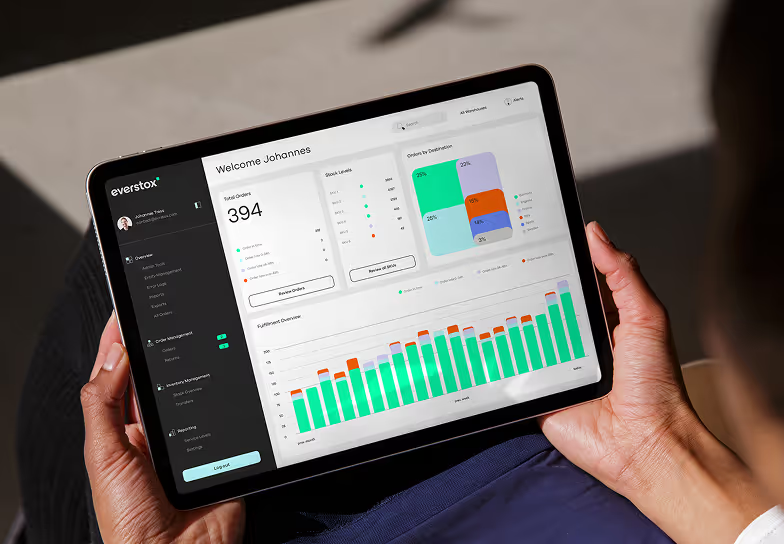
everstox helps you implement smart warehouse management – with a central platform, seamless multi-warehouse connectivity, and scalable fulfillment.
Frequently asked questions
How can warehouse capacity be conserved most effectively?
Which measures support safety in the warehouse and reduce costs?
How can a warehouse be used most efficiently?
What role does digital administration play in goods receipt and inventory control?
How can employees avoid bottlenecks caused by a lack of storage space?
About the author

Anna Kraus
eCommerce and logistics expert
With over seven years of experience in online marketing, Anna is responsible for the content strategy and editorial development of the everstox website. Her work focuses on eCommerce, logistics, and supply chain management, translating complex operational topics into clear, relevant, and actionable insights.
Since joining everstox in 2024, Anna has taken full ownership of the company’s editorial content, including blog articles, in-depth industry pieces, and the complete everstox glossary. Her content connects current trends in eCommerce and logistics with the real-world challenges faced by growing brands, helping decision-makers navigate an increasingly complex operational landscape.
Anna holds a bachelor’s degree from the University of Salzburg and earned a Master of Business Administration with a focus on health management from IU International University. Her master’s thesis on occupational health management reflects her analytical mindset and her interest in how integrated strategies can strengthen long-term business performance.
By combining academic rigor with hands-on marketing experience, Anna delivers content that goes beyond surface-level commentary. Her work offers readers a clear, well-informed perspective on the intersection of digital innovation, logistics, and supply chain operations, with a strong focus on practical relevance and strategic clarity.
More growth, less effort.
Scale fulfillment, shipping, and warehousing with a platform that brings everything together.
More interesting articles

Customs documents: how to avoid delays and in international trade
Your goods are packed, the carrier is booked, and the customer abroad is waiting for delivery – and suddenly everything comes to a halt. The reason: the shipment gets stuck in customs clearance. For eCommerce merchants and fulfillment providers, this is a worst-case scenario. It means delivery delays, unexpected storage fees, penalties, and frustrated customers.
The good news: many of these risks can be avoided with clear processes and complete customs documents – especially when all required documents are fully prepared and accurate.
This guide gives you a practical overview of which documents matter for export, how to avoid errors on the commercial invoice, and how automated customs declarations make your international growth scalable – from understanding liabilities to digital process optimization. Clean customs documentation is crucial in every section of the workflow, across any operational area.
Mastering seasonal peaks: how multi-warehousing helps prevent bottlenecks
Your marketing campaigns for Black Friday or the holiday season are running at full speed, the servers handle the traffic, orders skyrocket – and then everything stops. Not in your shop, but in the warehouse. When parcels remain stuck, throughput times explode and customers wait for their orders, the “logistics blackout” becomes reality.
A single warehouse location quickly turns into a “single point of failure” during peak season fulfillment. The solution for growing eCommerce and online retailers isn’t a bigger central warehouse, but flexibility: a strategy built on multi-warehousing.
This article shows you why decentralized warehousing has become essential in modern eCommerce. We break down the hidden risks of centralization, highlight the strategic advantages of a multi-warehousing setup and offer a clear guide on how to elevate your inventory management through automation and the right partner network.

Online marketplaces in Germany: opportunities for retailers and brands
Online marketplaces are digital platforms where multiple sellers offer their products, giving customers a wide selection. However, rising competition, high fees, and stricter quality requirements mean that sellers need a clear marketplace strategy and strong fulfillment partners to succeed.