

What is 4PL: definition and differences in logistics
6/6/2024

What is 4PL fulfillment?
There are many different warehousing and fulfillment models in logistics, both for internal and external “outsourced” logistics processing. These can be divided into various “PL” categories.
The term “PL” stands for “Party Logistics”. However, this has little to do with celebrations but refers to the degree to which logistics is outsourced and the number of parties involved: The higher the number in front of the “PL” the higher the degree of outsourcing of tasks and responsibilities and the higher the number of parties involved.
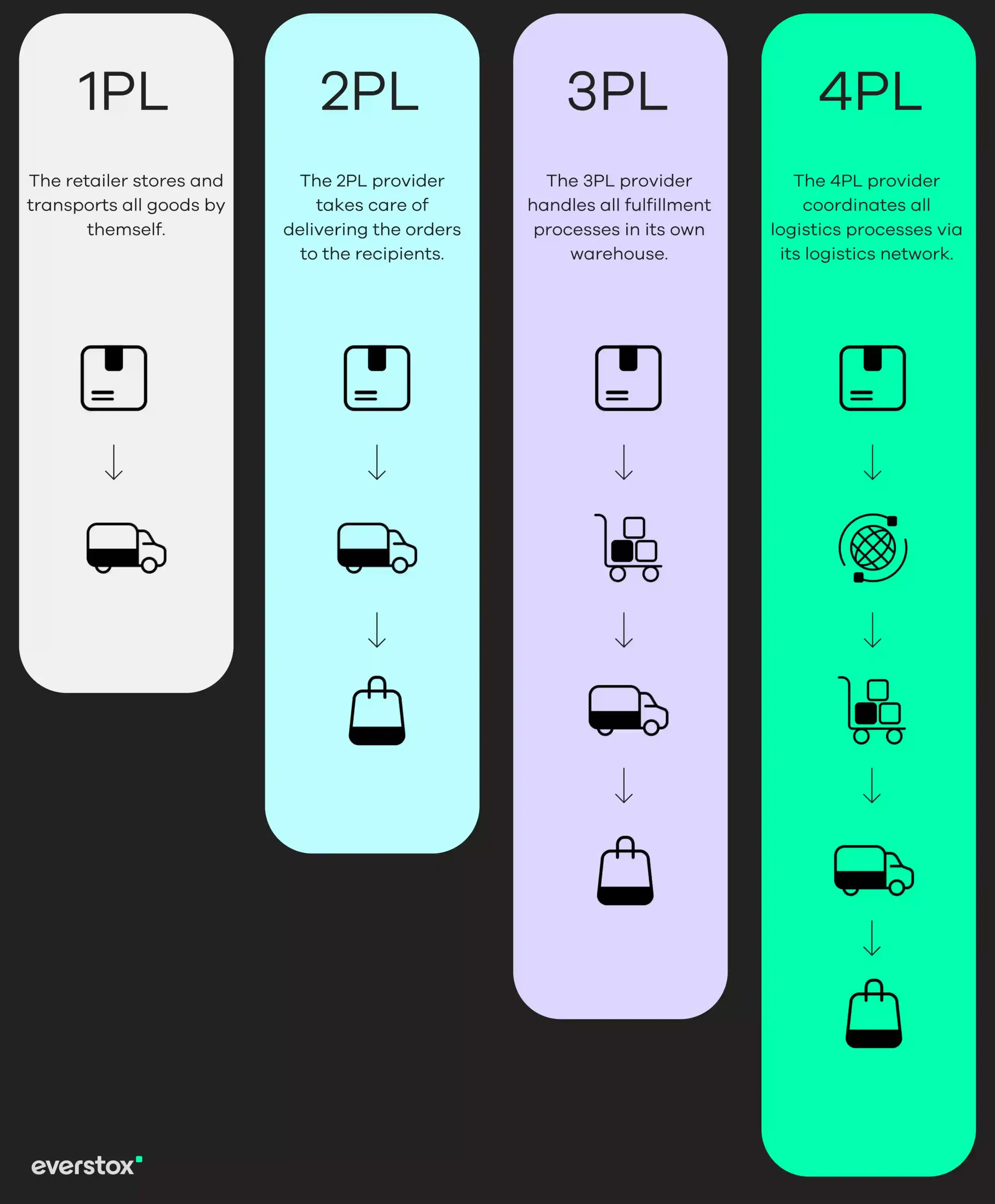
At the lower end of the “PL” spectrum, for example, is the 1PL model – the First Party Logistics model – in which the retailer does not outsource the logistics but takes care of storage, transportation, picking, and shipping of its products.
At the upper end of the spectrum, on the other hand, are logistics companies that take care of all storage, picking, and transport processes for their customers so that they no longer have to take care of their fulfillment. These include 4PL providers, for example.
Differences – 1PL vs. 2PL vs. 3PL vs. 4PL
1PL – First Party Logistics
Companies manage and transport their goods themselves. That gives them independence from external companies. However, they are severely limited in terms of capacity, flexibility, and scalability.
2PL – Second Party Logistics
2PL service providers handle the transportation of goods to the end customer and occasionally offer other primary logistics services. These include, for example, the storage of goods.
3PL – Third Party Logistics
A 3PL provider comprehensively handles logistics processes, including goods receipt, storage, picking, shipping, and returns management.
You can find a detailed description in our article “What is 3PL?”.
4PL – Fourth Party Logistics
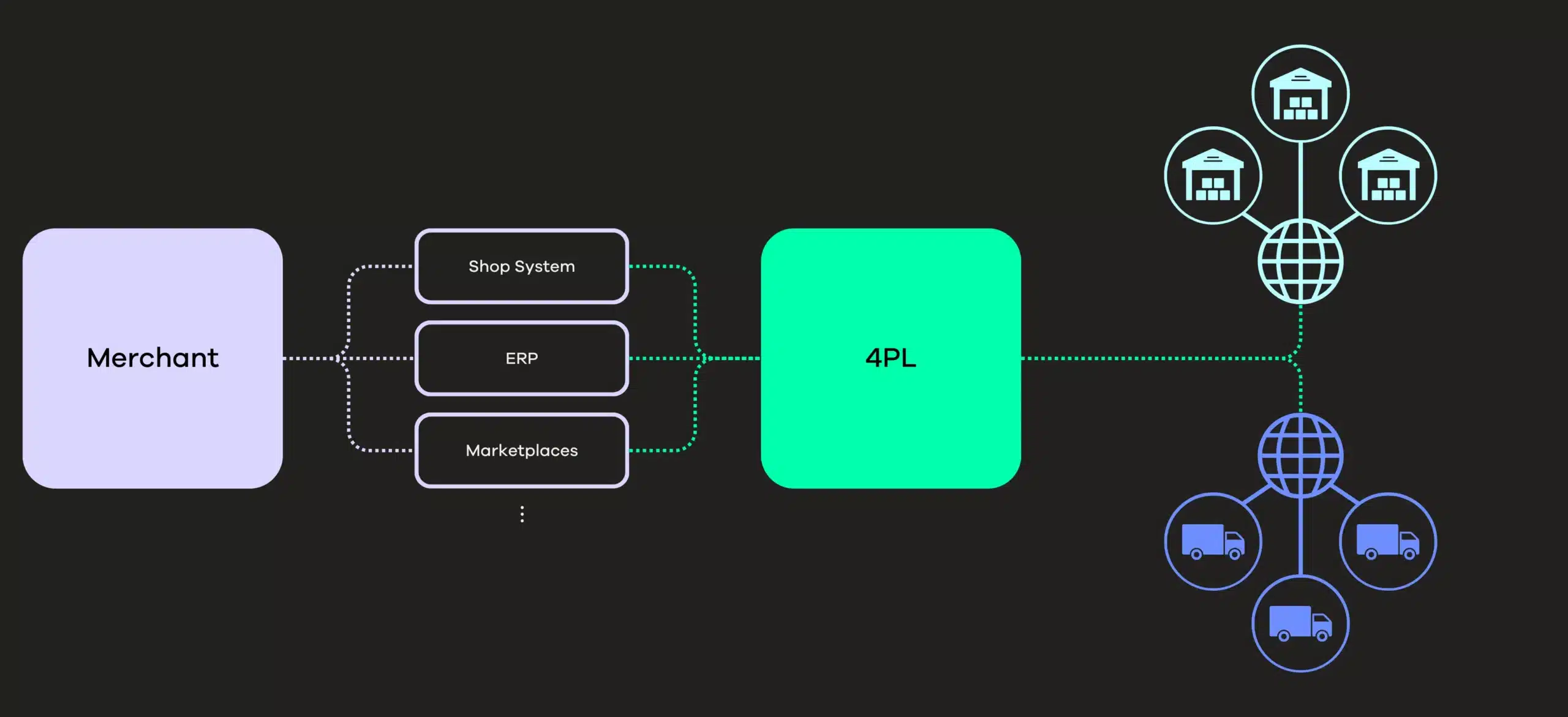
4PL service providers coordinate all logistics processes via a network of curated logistics partners without owning their warehouses or means of transportation.
What does a Fourth Party Logistics provider do?
The external 4PL logistics service provider – the so-called 4PL provider – plans, orchestrates, and coordinates all logistics processes for its customers without using its material resources (“assets”) for processing. These assets include, for example, own warehouses, own warehouse employees, own vehicles or delivery fleets, or similar equipment.
Instead, 4PL companies access various logistics service providers from their curated network and act as a fourth party to ensure that the data exchange and flow of goods between retailers, warehouses, and shipping service providers runs smoothly and seamlessly. They are characterized by capable, advanced technologies that they make available to their customers.
Advantages of the 4PL model
Fourth party logistics providers (4PL) represent a further development of traditional logistics outsourcing, offering several advantages over other logistics models such as third party logistics (3PL), second party logistics (2PL), or first party logistics (1PL).
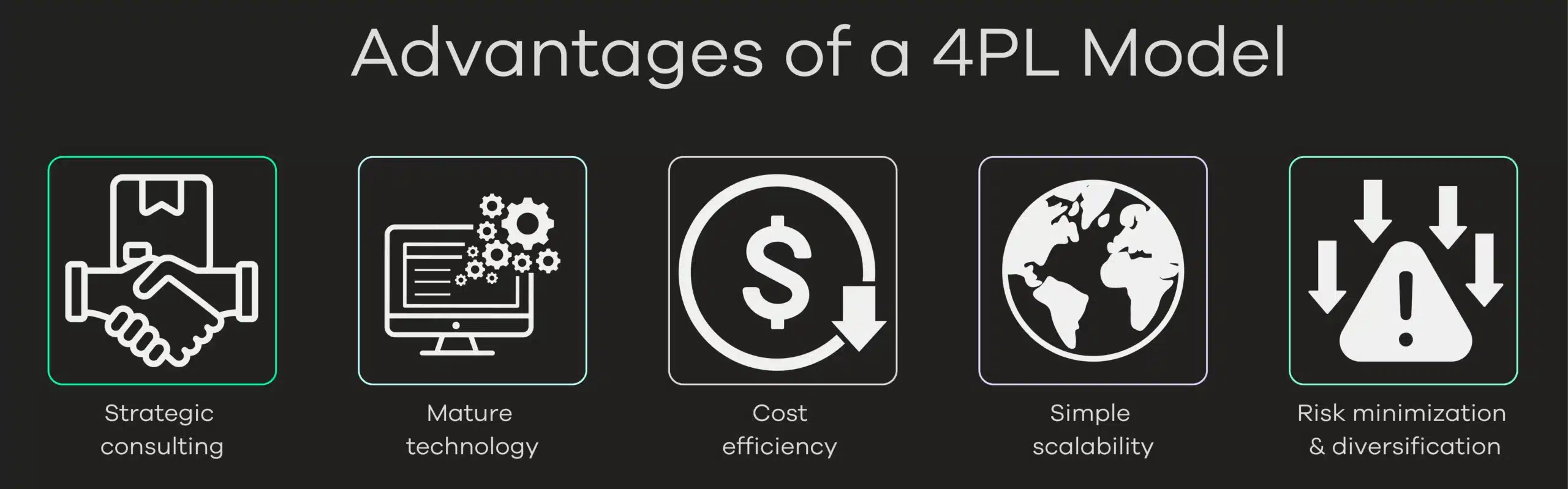
Strategic overview & consulting
4PL service providers handle all warehouse and fulfillment processes and have a holistic overview of every step of the supply chain from the moment of delivery. Beyond the standard operational processes, they work to improve the efficiency of your supply chain by identifying weak points and optimization potential and providing you with the appropriate advice.
For example, your 4PL company may advise you to open a warehouse in one of your markets once the local customer density has reached a certain level. Thanks to their expertise, advanced technology, and data analysis options, your strategic advisors can see when it is financially viable to replace cross-border shipments with local fulfillment.
Technical integrations & automation
A 4PL has comprehensive technical integrations and forms the interface between the warehouse management systems used in the connected warehouses and all systems on the customer side. The technology enables improved data integration, transparency, and analysis of the entire supply chain. It helps with sales forecasting, resource planning, and customer analysis, contributing to more informed strategic decision-making processes.
If you use multiple locations and/or sales channels, all order and return data is aggregated and synchronized in the 4PL system. That enables detailed analyses across all channels and warehouses and dynamic, real-time management of your stock levels and goods flows.
The data and intelligent automation can be used, for example, to prevent overstocking and understocking (“stock-outs”) by the 4PL software automatically sending stock alerts at the SKU level.
Cost efficiency & economies of scale
By adopting multiple fulfillment processes, 4PLs can optimize resource utilization and reduce costs through better routing, inventory management, and economies of scale. This approach can result in significant cost savings compared to in-house logistics or working with multiple separate providers.
A 4PL provider serves multiple customers from a shared warehouse and shipping network, significantly reducing overhead costs for each customer. For example, labor, warehouse space, and carriers are shared, lowering the cost per unit shipped for each customer.
Global expansion & internationalization
Typically, 4PLs have extensive global warehouse networks that allow customers to manage their international logistics more effectively. That is particularly beneficial for brands with global ambitions, as 4PLs can assist with import compliance, customs regulations, and other cross-border logistics challenges.
So in case you are looking to expand into new international markets, your 4PL service provider will be on hand to help you with local compliance, customs clearance, and partnerships with local shipping service providers, among other things. That allows you to benefit from a smooth market entry with efficient stock turnover and minimal legal hurdles.
Tailor-made fulfillment concepts & solutions
Thanks to their sizable, diversified warehouse network, 4PL companies can offer individual solutions that tailor to the specific needs of their customers. That allows them to serve brands from various industries and markets and build the best possible set-up in each case.
For example, if you have special requirements for storage, handling, or additional services, your 4PL will find you a perfectly suitable warehouse partner within its network. If your requirements change or expand, you can quickly and easily move to another suitable warehouse within the logistics network.
Risk minimization & diversification
By having access to a large warehouse and shipping network, a fourth party logistics provider minimizes its customers dependence on a warehouse or shipping service provider and the associated risk of failure.
Should a warehouse or transport company fail due to unforeseen environmental events, insolvency, or other reasons, it is possible to change to an alternative at short notice, thus ensuring the continuity of your supply chain.
A 4PL provider not only manages logistics, but is also constantly looking for ways to improve and innovate. This commitment to continuous optimization helps customers remain competitive in rapidly changing markets.
Disadvantages of the 4PL Model
Working with a 4PL can also have disadvantages:
Communication
Some (not all!) 4PL service providers follow a subcontracting model, where they use the warehouses in their network as subcontractors and sell the service in their name. All communication takes place exclusively via the 4PL service provider. That almost always leads to problems, as communication with the relevant people in the event of issues is tedious and lengthy.
At the beginning of discussions with a potential new service provider, you should ask what direct communication options you can establish with the warehouse.
Integration complexity
Integrating the provider’s technologies into the existing IT landscape can involve increased effort. Companies may have to adapt their processes to meet the requirements of the technologies.
Therefore, in discussions with potential 4PL partners, you should clarify in advance which system integrations are already offered as standard (e.g. with Shopify, Xentral, Odoo,…) and how complex or expensive the programming of new integrations is.
How to choose the right 4PL provider
To maximize efficiency in the supply chain, choosing the right fulfillment partner is crucial.
Several factors can make the switch to a provider either a success or a problem:
01 – Experience and expertise
The most suitable service provider for you will have extensive knowledge of logistics in addition to specific industry knowledge. The provider will be better able to respond to your particular needs and be aware of known stumbling blocks. Pay attention to whether the provider has already gained experience with your product type.
02 – Technological expertise
Providers should offer state-of-the-art technologies to keep up with the competition in today’s highly digital world. That includes, for example, software for shipment tracking, inventory management and process optimization. Using such technologies can improve the efficiency and productivity of your supply chain.
03 – Adaptability and flexibility
The ability to respond to unpredictable market developments is an equally important factor. Your provider should be able to adapt flexibly to new circumstances and offer specific solutions, such as scaling capacity according to demand.
04 – Geographical coverage
Do you want to expand, or at least not rule it out completely? When selecting your logistics service provider, confirm this option is included in the range of services. The provider should be internationally positioned or have an international network, as this lowers the barrier to entry into new markets and supports you during your expansion.
05 – Reputation
Also find out about the reputation of your potential provider. Case studies or references can be helpful to find out more about the logistics service provider’s previous work and to better assess their professionalism and reliability.
Is a 4PL provider the right fit for your eCom business?
Choosing the right fulfillment partner is crucial, but with suitable support, it doesn’t have to be complicated. everstox offers a platform that combines B2C and B2B fulfillment, multi-carrier B2C or B2B shipping, and modern software to simplify your eCommerce logistics.
Not sure if everstox is the right solution for you?
Our fulfillment experts are happy to provide you with a free assessment of your needs and a comprehensive consultation so you can make a educated, stress-free decision.
Frequently asked questions
What is 4PL?
What special services does a 4PL offer?
What does a 4PL partner cost?
Is a 3PL provider enough for my eCommerce business?
About the author

Anna Kraus
eCommerce and logistics expert
With over seven years of experience in online marketing, Anna is responsible for the content strategy and editorial development of the everstox website. Her work focuses on eCommerce, logistics, and supply chain management, translating complex operational topics into clear, relevant, and actionable insights.
Since joining everstox in 2024, Anna has taken full ownership of the company’s editorial content, including blog articles, in-depth industry pieces, and the complete everstox glossary. Her content connects current trends in eCommerce and logistics with the real-world challenges faced by growing brands, helping decision-makers navigate an increasingly complex operational landscape.
Anna holds a bachelor’s degree from the University of Salzburg and earned a Master of Business Administration with a focus on health management from IU International University. Her master’s thesis on occupational health management reflects her analytical mindset and her interest in how integrated strategies can strengthen long-term business performance.
By combining academic rigor with hands-on marketing experience, Anna delivers content that goes beyond surface-level commentary. Her work offers readers a clear, well-informed perspective on the intersection of digital innovation, logistics, and supply chain operations, with a strong focus on practical relevance and strategic clarity.
More growth, less effort.
Scale fulfillment, shipping, and warehousing with a platform that brings everything together.
More interesting articles

Customs documents: how to avoid delays and in international trade
Your goods are packed, the carrier is booked, and the customer abroad is waiting for delivery – and suddenly everything comes to a halt. The reason: the shipment gets stuck in customs clearance. For eCommerce merchants and fulfillment providers, this is a worst-case scenario. It means delivery delays, unexpected storage fees, penalties, and frustrated customers.
The good news: many of these risks can be avoided with clear processes and complete customs documents – especially when all required documents are fully prepared and accurate.
This guide gives you a practical overview of which documents matter for export, how to avoid errors on the commercial invoice, and how automated customs declarations make your international growth scalable – from understanding liabilities to digital process optimization. Clean customs documentation is crucial in every section of the workflow, across any operational area.
Mastering seasonal peaks: how multi-warehousing helps prevent bottlenecks
Your marketing campaigns for Black Friday or the holiday season are running at full speed, the servers handle the traffic, orders skyrocket – and then everything stops. Not in your shop, but in the warehouse. When parcels remain stuck, throughput times explode and customers wait for their orders, the “logistics blackout” becomes reality.
A single warehouse location quickly turns into a “single point of failure” during peak season fulfillment. The solution for growing eCommerce and online retailers isn’t a bigger central warehouse, but flexibility: a strategy built on multi-warehousing.
This article shows you why decentralized warehousing has become essential in modern eCommerce. We break down the hidden risks of centralization, highlight the strategic advantages of a multi-warehousing setup and offer a clear guide on how to elevate your inventory management through automation and the right partner network.

Online marketplaces in Germany: opportunities for retailers and brands
Online marketplaces are digital platforms where multiple sellers offer their products, giving customers a wide selection. However, rising competition, high fees, and stricter quality requirements mean that sellers need a clear marketplace strategy and strong fulfillment partners to succeed.