

Internationalization in eCommerce – the ultimate guide
11/14/2025
Your eCommerce business is growing and as an online retailer you want to tap into new markets? Strong decision. Expansion abroad, also called cross-border eCommerce to e.g. the US, is the logical next step for ambitious companies. For vision to turn into revenue, you need clarity: how do you approach the internationalization of eCommerce, your online retail and your shipping in a strategic way? This guide takes you through all phases – from market analysis and legal hurdles to logistics and online marketing.
We’ll show you which challenges in eCommerce internationalization really matter, which solutions work, and how you can minimize logistical risks and boost your competitiveness with a local presence.
What does internationalization in eCommerce mean?
Internationalization in eCommerce is the strategic process by which an online retailer expands its shops beyond the country of origin into new territories. The goal is measurable growth through a larger customer base – not as an end in itself, but as a clear lever for revenue, margin, and brand awareness. The journey from local online retail to a globally active B2C business goes far beyond simple translation. Successful eCommerce internationalization involves four closely interlinked dimensions with major advantages but also demanding challenges:
- the development of a clear eCommerce strategy for market selection,
- the technical adaptation of eCommerce platforms through localization and compliance with the applicable national laws on legal requirements and taxes,
- as well as the efficient organization of logistics including cross-border shipping.
A good example shows: only those who think strategy and logistics together achieve an implementation that scales internationally. Our goal: less friction, more reach – and a setup that works worldwide.
Phase 1: strategy & market analysis – setting the right course
Before you start, a solid eCommerce strategy is crucial. Selling globally opens up huge opportunities, but it requires a plan that actively addresses risks. Careful preparation minimizes pitfalls and maximizes your chances of success. The importance of market selection can hardly be overstated.
How do I find the right target markets?
Not every market fits your offering. Analyze potential countries in a data-driven way. The basis is a structured evaluation that takes regional specifics into account:
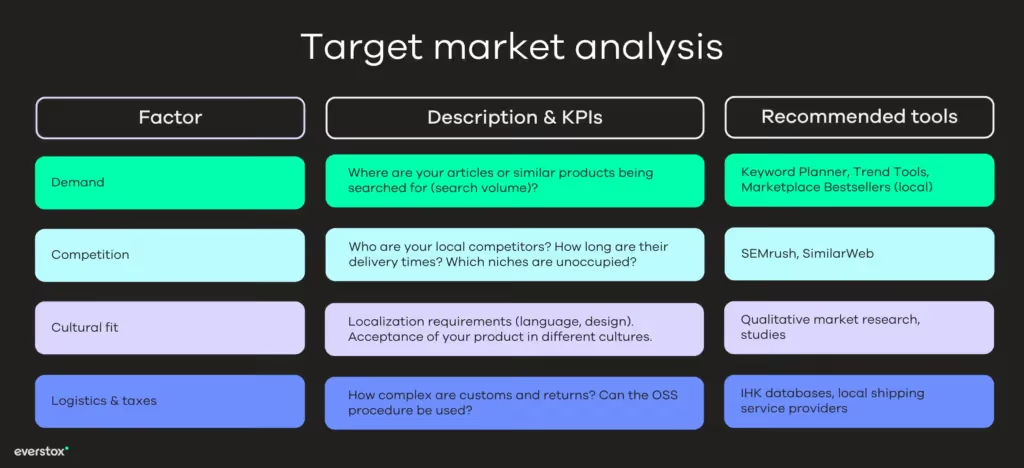
This is the first step to structurally unlocking the potential of global online retail.
A practical example: a German fashion shop uses trend data to analyze demand behavior in Scandinavia and realizes that its products perform particularly well there. This creates a clear focus for the next expansion step – and clean execution.
Marketplace vs own shop: market entry strategy
You don’t have to start with a fully localized online shop right away. A proven market entry strategy is selling via international eCommerce platforms such as Amazon or Zalando to test a market. In the long term, however, an own localized shop offers more control over brand and customer data and is essential for sustainable brand building and a stable customer base. In short: test on the marketplace, scale in your own shop – that’s the smart solution in modern online sales.
Phase 2: law, taxes & customs – the foundation for global trade
This part is complex – and absolutely crucial. A clean compliance setup has a direct impact on scalability and delivery promises. Modern digital solutions help you manage this complexity.
Keeping taxes under control: the OSS procedure explained simply
Since 1 July 2021, the One-Stop-Shop (OSS) procedure has simplified the reporting and payment of VAT for B2C distance sales within the EU. Once your EU-wide net revenue from B2C distance sales exceeds €10,000 per year, you must charge VAT at the respective national rate. With OSS, you report these centrally in your member state of identification. Note: IOSS applies to import consignments up to €150 from third countries; B2B revenue and certain product groups (e.g. excise goods) cannot be handled via OSS. The result: less administrative effort, more focus on growth and execution.
Incoterms & customs: who bears the risk?
To manage international shipping and customs formalities smoothly, Incoterms are indispensable. They shape the customer experience and cost split. Incoterms are globally recognized rules issued by the ICC that apply when agreed contractually. They regulate transfer of risk, allocation of costs and obligations, but are not customs or tax law.
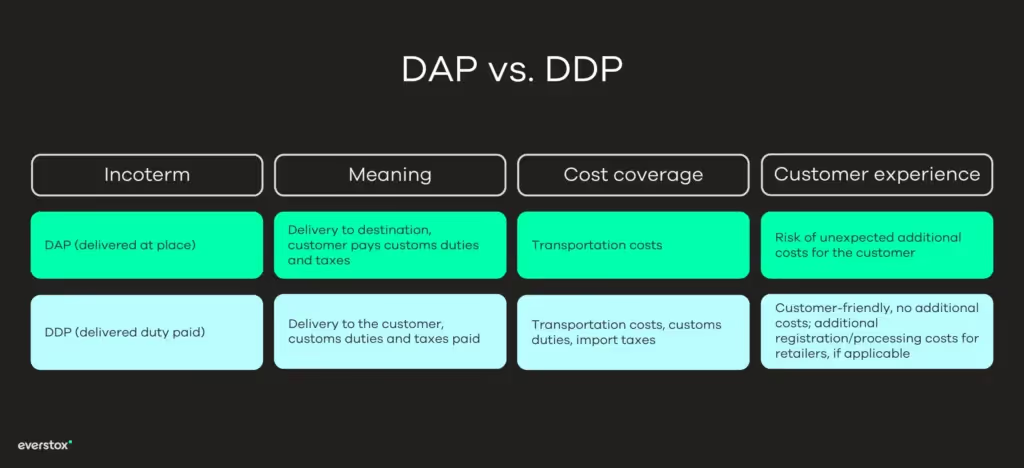
Tip: DDP can often provide the best customer experience in eCommerce, but sometimes requires fiscal representation / registration in the destination country and a robust cost calculation. Alternatively, DAP makes sense if customs clearance is to remain with the recipient. Nothing should be left to chance here – every detail counts.
Essential for export
EORI number: your unique customs number. Required for export and import in trade with non-EU countries.
Commercial invoice: mandatory for every shipment to a non-EU country. Includes HS code (tariff number), product value, country of origin, quantity / description as well as invoice / shipping data. Clean documentation means faster clearance – a good example of efficient processes.
Phase 3: shop system & technology for internationalization in eCommerce
Your online shop must be ready for an international audience. This goes far beyond translation – it is the technical component of your eCommerce internationalization.
Localization: more than just translation
Successful internationalization creates a local shopping experience with familiar signals and a frictionless checkout:
- Currency & payment methods: Show prices in the local currency and offer preferred payment methods (e.g. iDEAL in NL, Klarna in Scandinavia) to measurably increase your conversion rate.
- Legal texts: Adapt T&Cs, cancellation policy, imprint and mandatory information (e.g. price indication / consumer information) to local law – clean, transparent, legally compliant.
- Units of measure: Use local measurement systems (e.g. imperial system in the US) and correct size indications (e.g. UK sizes in fashion). This avoids questions and returns.
Another example: a French shop builds trust by integrating local payment methods and thus increases conversion by 12% – a clear signal of the role localization plays.
International SEO & geotargeting
For customers to find you, your shop needs a strong technical foundation:
Hreflang tags
Tell search engines which language or country version is relevant for whom – and reduce duplicate content risks.
Domain structure
Country-code domains, subdomains or subdirectories – subdirectories are often a pragmatic starting point, but the optimal structure depends on IT setup, governance, SEO goals and CDN / hosting strategy.
Loading times
Fast hosting, ideally via CDN, ensures short loading times and a better user experience globally. Every millisecond counts.
Phase 4: shipping, logistics & returns – key aspects of internationalization
International shipping is the heart of your global business. An optimized supply chain is your performance booster here.
Multi-carrier and multi-warehousing as logistics levers
Multi-carrier strategy
Choose the best international shipping provider per destination country, parcel size, and desired delivery time. A shipping service provider (SSP) controls the selection based on rules and criteria (e.g. destination country, transit time, service level, price, performance), including fallback rules for disruptions or peak loads. The result: better planning reliability and more stable delivery times.
Multi-warehousing
The strongest lever to shorten transit time. By storing inventory in local fulfillment centers (e.g. in Poland for Eastern Europe), you significantly reduce distance and delivery time on the last mile. Prerequisites are centralized inventory / order synchronization and clear routing rules to avoid overselling and stockouts.
Fulfillment partners
Platforms like everstox give you access to a network of specialized logistics centers in Europe and the US – including connection to multiple 3PLs / carriers, central order / stock / shipment reporting, and rule-based carrier management. Your existing shop / ERP / WMS systems remain integrated. You benefit from professional processing and pre-negotiated conditions, which lowers shipping costs and improves delivery performance.
A strong example: a D2C shop in Germany uses a second warehouse in Italy – and halves its average delivery time to Southern Europe. This turns logistics into a competitive advantage.
Handling returns from abroad efficiently
A clear, simple returns management process is essential. Offer customers an uncomplicated return – ideally to a local returns hub, depending on return volume and product group. A local hub speeds up refunds and reduces costs, but requires clean checking and refurbishing processes and, if applicable, customs procedures for returned goods (e.g. Returned Goods Relief). Accepting the return in the destination country enables quick refunds and protects against expensive individual returns across borders. A local returns address and professional inspection at goods-in are essential. Effective solutions at this stage have a direct impact on customer satisfaction and sustainability.
Phase 5: international marketing & customer service – winning and retaining customers
A localized shop is only half the job. The second half is communication that resonates – and service that delights. Both play a central role in sustainable growth in the B2C space.
Local marketing: increasing AOV and CLV
Adapt your ads culturally and analyze which social media channels are strong in your target country. Focus on metrics that drive value:
- Average Order Value (AOV) and Customer Lifetime Value (CLV) are your guiding metrics.
- Free shipping above a minimum order value can be very powerful but must fit your margin, average shipping costs, and return rate.
- Translation: rely on professional native translators so messages land and trust is built. Every message counts.
Building multilingual customer support
Excellent service is a buying argument worldwide. Provide native-language support aligned with local time zones. AI-supported translations can be the first point of contact, but for complex issues, trained human support remains unbeatable. The result: less friction, stronger loyalty, and clear solutions when questions arise.
What does internationalization really cost for eCommerce companies?
The cost question is central – transparency enables decisions. Typical cost items when calculating your online shop expansion:
- Law & taxes: Specialized legal advice for adapting T&Cs, data protection, etc., and ongoing effort for OSS / IOSS filings (internal processes or service provider fees).
- Translation & localization: Professional translators (e.g. €0.15–0.25 per word).
- Technology & shop system: Fees for multilingual shop plugins, apps for currency conversion or country-specific payment providers.
- Marketing & advertising: Test budgets for campaigns (plan at least €2,000–10,000 for the start), potentially local influencers or SEO agencies.
- Logistics & fulfillment: Higher shipping costs, fees for a fulfillment partner for storage and processing in the destination country, potential customs duties (if not shipped DDP).
A fulfillment partner can turn fixed capital costs into variable costs and noticeably reduce the initial investment – without sacrificing speed and transparency. For many companies, this is the decisive step in implementing their international project.
Internationalization in eCommerce with everstox
Ready for the next step? everstox helps you implement eCommerce internationalization intelligently – with a Europe-wide fulfillment network, multi-warehousing to reduce delivery times, and rule-based, automated multi-carrier management for cross-border shipments. A central platform connects your systems, makes inventory, orders, and shipments transparent, and frees up your time for growth.
Get in touch now and grow globally. Your project for international success starts here – with solutions that work in the real world.
Frequently asked questions
What is the difference between internationalization and localization?
How do I reduce my shipping costs and delivery times abroad?
What impact do local payment methods have on the conversion rate?
What is the legal regulation for delivery times in international shipping?
About the author

Anna Kraus
Expert for eCommere & logistics
With over seven years of experience in online marketing, Anna is responsible for the content strategy and editorial development of the everstox website. Her work focuses on eCommerce, logistics, and supply chain management, translating complex operational topics into clear, relevant, and actionable insights.
Since joining everstox in 2024, Anna has taken full ownership of the company’s editorial content, including blog articles, in-depth industry pieces, and the complete everstox glossary. Her content connects current trends in eCommerce and logistics with the real-world challenges faced by growing brands, helping decision-makers navigate an increasingly complex operational landscape.
Anna holds a bachelor’s degree from the University of Salzburg and earned a Master of Business Administration with a focus on health management from IU International University. Her master’s thesis on occupational health management reflects her analytical mindset and her interest in how integrated strategies can strengthen long-term business performance.
By combining academic rigor with hands-on marketing experience, Anna delivers content that goes beyond surface-level commentary. Her work offers readers a clear, well-informed perspective on the intersection of digital innovation, logistics, and supply chain operations, with a strong focus on practical relevance and strategic clarity.
More growth, less effort.
Scale fulfillment, shipping, and warehousing with a platform that brings everything together.
More interesting articles

Fulfillment vs. growth – insights from the abscale podcast
As eCommerce brands grow, fulfillment setups that once worked often start to show their limits.
Not because operations fail - but because complexity increases and the underlying model doesn’t evolve with it.
This is exactly what Johannes Tress discusses in the abscale podcast, and why many fulfillment setups reach a point where they no longer scale.

%20(1704%20x%20960%20px)%20(1).avif)
Logistics out of control? Insights from the UNHYDE podcast
In a recent episode of the UNHYDE podcast, our Co-Founder Johannes Tress shares what actually changes in this phase, and why many eCommerce brands start running into structural challenges long before they realize it.
This article breaks down those patterns and explains where control is typically lost - and what distinguishes setups that scale from those that don’t.

Customs documents: how to avoid delays and in international trade
Your goods are packed, the carrier is booked, and the customer abroad is waiting for delivery – and suddenly everything comes to a halt. The reason: the shipment gets stuck in customs clearance. For eCommerce merchants and fulfillment providers, this is a worst-case scenario. It means delivery delays, unexpected storage fees, penalties, and frustrated customers.
The good news: many of these risks can be avoided with clear processes and complete customs documents – especially when all required documents are fully prepared and accurate.
This guide gives you a practical overview of which documents matter for export, how to avoid errors on the commercial invoice, and how automated customs declarations make your international growth scalable – from understanding liabilities to digital process optimization. Clean customs documentation is crucial in every section of the workflow, across any operational area.